How AI Changed the Scam Game
Listen to this lesson
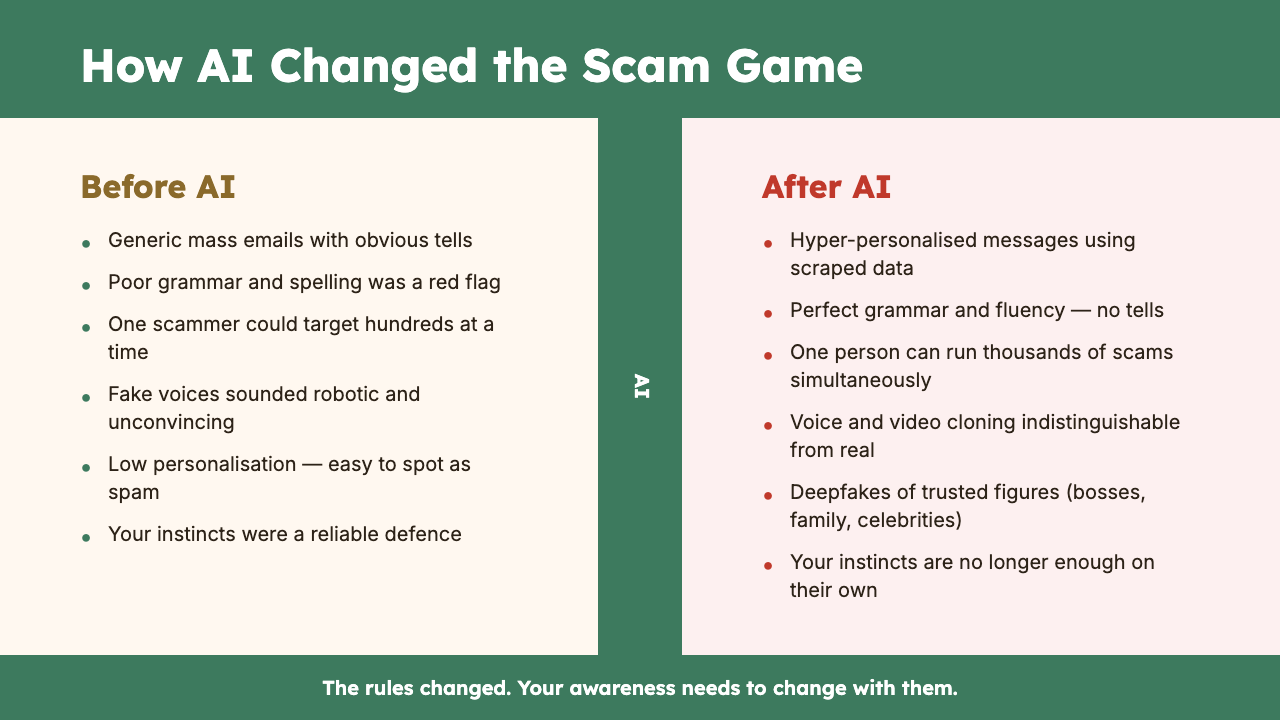
For a long time, spotting a scam was fairly straightforward. The email had terrible spelling. The grammar was awkward. The whole thing looked like it had been translated from another language by someone in a hurry. If something felt a bit off, you could usually trust that instinct.
That is no longer the case.
Artificial intelligence has handed scammers a set of tools that would have seemed like science fiction five years ago. Today, AI can write a flawless email in seconds. It can build a convincing fake website overnight. It can clone a person's voice from a short audio clip. It can generate a fake face, a fake identity, even a fake video call. And it can do all of this at a scale that was never before possible.
The old red flags are gone
Most people have been taught to look for:
- Poor spelling and grammar
- Odd phrasing or unusual word choices
- Generic greetings like "Dear Customer"
- Obvious logos that look slightly wrong
AI has eliminated nearly all of these. A scam email today can read as naturally as a message from your bank. It can address you by name, reference your suburb, mention recent events, and be formatted perfectly. There is nothing left to catch your eye.
This is not a small change. It means the gut-check most of us relied on is no longer reliable.
Scale is the other shift
In the past, scammers had to write each message manually. That limited how many people they could target. Now, a single person running AI tools can send thousands of personalised messages simultaneously — each one tailored to a different recipient, with their name, their interests, their recent activity.
New Zealanders are losing more than NZ$5 million per quarter to scams and fraud, according to data from the National Cyber Security Centre. CERT NZ's Q1 2026 report showed a 12% increase in reported incidents compared to the previous quarter, with $5.8 million in direct financial losses. Netsafe separately reported nearly $65,000 lost to scams in just the first three months of 2026 — and that figure captures only the incidents reported to them. The true total is far higher, as most scam victims never report.
Globally, more than 580 new malicious AI-generated websites are appearing every single day. Criminal networks have begun packaging AI voice cloning, deepfake video, fake website generators, and targeted messaging tools into ready-made fraud kits — known as "Scam-as-a-Service" — which let even technically unskilled criminals launch sophisticated, AI-powered campaigns.
These are not abstract numbers. They reflect real people — people like your neighbours, your parents, your colleagues — being caught out by scams that are genuinely hard to detect.
Why this is not about being gullible
It is important to say this plainly: falling for a modern AI-powered scam does not mean someone is stupid or careless. These scams are engineered to exploit normal human behaviour — trust, urgency, love, fear. The people building them are professionals who test and refine their techniques constantly.
The people targeted are often smart, educated, and careful. They are caught because the scam was convincing — not because they failed to pay attention.
What this means for you
You cannot rely on the same signals you used to. You need a different approach.
The good news is that the protection strategies are simple and do not require any technical knowledge. They come down to a few habits:
- Slow down before acting on anything unexpected
- Verify through a channel you control, not one the message gives you
- Know the current scam patterns so you recognise what you are looking at
The lessons in this course cover the most common AI-powered scams circulating in New Zealand right now — what they look like, who they target, and exactly what to do. By the end, you will have a practical checklist you can share with the people you care about.
Scams work best when people do not know they exist. The more people know, the harder they become to run.
Visual overview