Module 7, Lesson 1: Current State of AI Adoption in NZ Businesses
Listen to this lesson
Module 7, Lesson 1: Current State of AI Adoption in NZ Businesses
Estimated reading time: 8 minutes
What You'll Learn
Module 7 is where this course becomes something no other AI course offers: a grounded, practical look at AI in the context of Aotearoa New Zealand. Not Silicon Valley theory applied to our market, but what's actually happening here — the adoption, the hesitation, the opportunities, and the challenges specific to a small, innovative country at the bottom of the Pacific.
Where NZ Stands Right Now
New Zealand businesses are adopting AI, but the picture is uneven. We're not leading the world, and we're not lagging behind either. The reality is more nuanced than either the boosters or the sceptics suggest.
According to the Ministry of Business, Innovation and Employment (MBIE), AI adoption among New Zealand businesses has been growing steadily, with a notable acceleration since ChatGPT's public launch in late 2022. Recent data from Microsoft highlights a staggering potential economic impact, suggesting that AI could add up to $102 billion to New Zealand's GDP over the next decade if adopted effectively across sectors. However, adoption varies enormously by sector, company size, and what we mean by "adoption."
The Adoption Spectrum
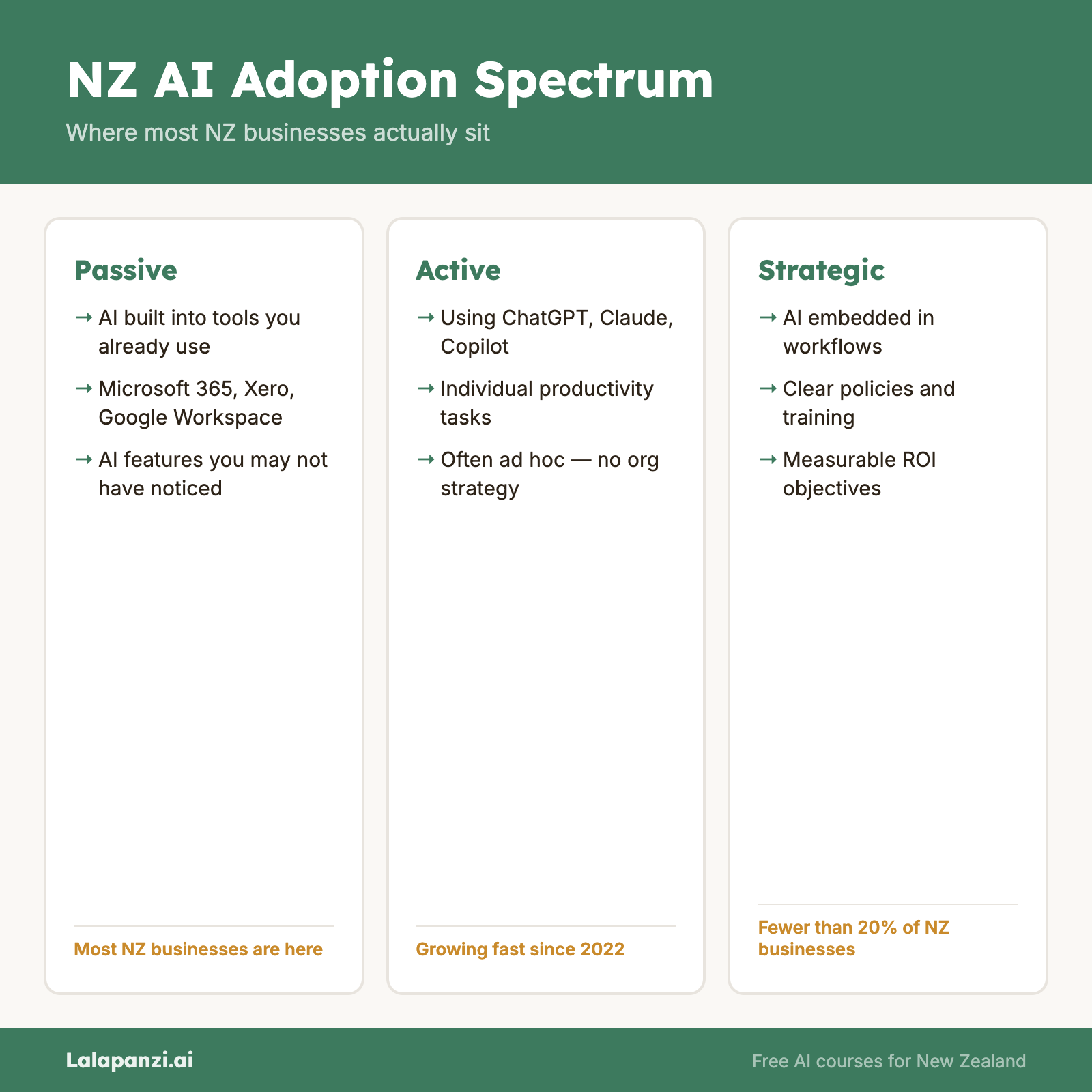
It helps to think of AI adoption on a spectrum:
Passive adoption — using AI features built into tools you already have. If you use Microsoft 365, Google Workspace, or Xero, you're already using AI whether you realise it or not. Spell-check, smart replies, automated categorisation, fraud detection — these are all AI features embedded in everyday business tools. Most NZ businesses are here.
Active experimentation — individuals within a business using tools like ChatGPT, Claude, or Copilot for specific tasks. Writing emails, summarising documents, brainstorming ideas. According to available information, a survey by the NZ AI Forum found that a significant proportion of NZ workers had used generative AI tools for work tasks. But this is often happening ad hoc, without organisational guidance or strategy.
Strategic adoption — the organisation has deliberately incorporated AI into workflows, with policies, training, and measurable objectives. This is where far fewer NZ businesses sit. Larger enterprises and some tech-forward SMEs are here, but for most, AI is still an individual productivity tool rather than an organisational capability.
AI-native operations — the business model itself is built around AI capabilities. A small but growing number of NZ startups and tech companies operate here.
The SME Reality
New Zealand's economy runs on small and medium enterprises. According to available information, over 97% of NZ businesses have fewer than 20 employees. This shapes our AI adoption story significantly:
- Resource constraints. SMEs often lack dedicated IT staff, let alone AI specialists. Adoption depends on the owner or a tech-savvy team member experimenting on their own.
- Practical focus. NZ SMEs tend to adopt technology when it solves an immediate, tangible problem — not because it's trending. AI tools that save time on admin, improve customer communication, or reduce manual data entry get traction. Abstract "AI strategy" doesn't.
- Trust and caution. Many SME owners are cautious about tools that handle customer data or automate decisions. This isn't technophobia — it's the pragmatism of people who know that a data breach or a bad customer experience can sink a small business.
What NZ Businesses Are Actually Using AI For
Based on available research and industry reports, the most common AI use cases in NZ businesses include:
-
Content creation and communication. Drafting emails, social media posts, marketing copy, and customer communications. This is the gateway use case for most businesses.
-
Customer service. Chatbots and automated response systems, though many NZ businesses find that their customers still prefer human interaction, especially for complex queries.
-
Data analysis and reporting. Using AI to summarise data, spot trends, and generate reports — particularly valuable for businesses that collect lots of data but lack analytics capability.
-
Administrative automation. Meeting transcription, scheduling, invoice processing, and document management.
-
Code and technical assistance. Developers and technical staff using AI coding assistants like GitHub Copilot or Cursor.
The Barriers
Several factors slow AI adoption in New Zealand specifically:
Skills gap. There's a shortage of people who understand AI well enough to implement it effectively. Not AI researchers — we're talking about everyday businesspeople who can evaluate, adopt, and manage AI tools. (This is exactly the gap our course aims to fill.)
Connectivity. While urban NZ has decent internet, rural and remote areas — where significant economic activity happens, particularly in agriculture — face connectivity challenges that limit cloud-based AI tool usage.
Cost concerns. Enterprise AI tools carry subscription costs that feel significant for small businesses operating on tight margins. The free tiers are useful but limited.
Uncertainty about regulation. Businesses are hesitant to invest heavily in AI when the regulatory environment is still evolving. "What if we build processes around tools that get regulated out of existence?" is a real concern, even if it's probably overblown.
Cultural factors. New Zealand has a strong "number 8 wire" culture of practical, hands-on problem-solving. Some business owners feel that AI is a shortcut that doesn't align with this ethos. Others see AI as the ultimate number 8 wire — a versatile tool you can bend to fit whatever problem you've got.
The NZ AI Ecosystem
It's worth knowing what support exists:
- AI Forum New Zealand (aiforum.org.nz) is the country's leading AI industry body. They publish research, run events, and advocate for responsible AI adoption.
- MBIE provides guidance and funding opportunities related to digital transformation, including AI.
- Callaghan Innovation supports businesses exploring emerging technologies, including AI applications.
- NZTech represents the broader technology sector and includes AI within its scope.
- The NZ AI Strategy (published July 2025) sets out the government's approach to AI adoption, innovation, and responsible use across the economy. The strategy confirmed a deliberately "light-touch and principles-based" approach — focusing on removing legislative barriers to AI adoption and aligning with OECD AI principles rather than introducing AI-specific regulation. Existing frameworks like the Privacy Act 2020 and the Algorithm Charter remain the primary regulatory tools.
- The Public Service AI Framework provides guidance for all public service agencies on adopting AI responsibly, with a 2-year work programme led by the Government Chief Digital Officer to modernise public services through safe and trustworthy AI use.
- Aotearoa Agentic AI Platform (AAAIP) — Announced by MBIE in March 2026, this national initiative aims to augment New Zealand's 5 million population with 100 million AI assistants. The platform represents a significant investment in AI infrastructure for economic growth and positions NZ as a testing ground for agentic AI deployment at scale.
- AI-powered scam threat — By mid-2026, the Financial Markets Authority warned that AI-driven scams (voice cloning, deepfake video, synthetic identities) are costing New Zealanders an estimated $265 million annually. In July 2026, the Westpac NZ chief executive was targeted by a deepfake image used in fraudulent investment ads on social media. This has prompted calls for specific legislation to address AI-enabled fraud, though the government's light-touch approach means existing fraud and consumer protection laws are being relied upon for now.
- Universities — Auckland, Canterbury, Victoria, Waikato, and others have active AI research programmes and some offer industry partnerships.
What This Means for You
If you're reading this course, you're already ahead of many NZ business users when it comes to understanding AI. The opportunity in Aotearoa isn't about being first — it's about being thoughtful. New Zealand businesses that adopt AI strategically, with attention to our specific context (small teams, relationship-driven business culture, regulatory environment, te ao Māori), will get more value than those who simply copy what American tech companies are doing.
The chapters ahead in this module will dig into the specifics: privacy law, industry applications, indigenous data sovereignty, and where the genuine opportunities lie.
Key Takeaways
- NZ AI adoption is growing but uneven — most businesses are in the passive or experimental stages, with few having strategic AI plans.
- SMEs dominate the NZ economy and face specific challenges in AI adoption, including resource constraints, connectivity, and cost.
- The most common AI uses in NZ businesses are content creation, customer service, data analysis, and administrative automation.
- Skills gaps and regulatory uncertainty are significant barriers, alongside practical issues like connectivity in rural areas.
- NZ has a growing AI ecosystem including the AI Forum, Callaghan Innovation, and university research programmes.
Practical Exercise
AI Adoption Self-Assessment (15 minutes)
- Think about your own workplace (or a business you know well). Place it on the adoption spectrum:
- Passive adoption (AI embedded in existing tools)
- Active experimentation (individuals using AI tools ad hoc)
- Strategic adoption (organisational AI strategy and policies)
- AI-native (business model built around AI)
- List three specific tasks in your work that AI tools could help with today.
- For each task, identify:
- Which AI tool would be most suitable?
- What's the main barrier to adoption? (Skills, cost, policy, trust, connectivity?)
- What would need to happen for your workplace to move one step along the spectrum?
- Write a brief (3-5 sentence) recommendation to your manager or business owner about where to start with AI adoption.
Knowledge Check
Question 1: What percentage of New Zealand businesses have fewer than 20 employees?
A) About 50% B) About 75% C) Over 97% D) About 85%
Answer: C — Over 97% of NZ businesses are SMEs with fewer than 20 employees. This shapes AI adoption patterns significantly, as small businesses face different constraints and opportunities than large enterprises.
Question 2: Which of the following best describes the current state of AI adoption in most NZ businesses?
A) Most businesses have comprehensive AI strategies with dedicated AI teams B) Most businesses are at the passive or experimental stage — using AI features in existing tools or having individuals experiment with tools like ChatGPT C) NZ businesses have rejected AI and are not adopting it D) AI adoption in NZ is identical to adoption rates in the United States
Answer: B — While adoption is growing, most NZ businesses are either passively using AI through embedded features or at the stage where individuals are experimenting with generative AI tools without formal organisational strategy.
Question 3: Which of the following is NOT a commonly cited barrier to AI adoption for NZ businesses?
A) Skills gaps in understanding and implementing AI B) Internet connectivity challenges in rural areas C) Government ban on AI use in business D) Uncertainty about the evolving regulatory environment
Answer: C — There is no government ban on AI use in NZ businesses. The actual barriers include skills gaps, connectivity issues (especially rural), cost concerns for SMEs, and uncertainty about future regulation.
Visual overview