Module 7, Lesson 4: Te Tiriti Considerations and Indigenous Data Sovereignty
Listen to this lesson
Module 7, Lesson 4: Te Tiriti Considerations and Indigenous Data Sovereignty
Estimated reading time: 9 minutes
What You'll Learn
This is possibly the most important lesson in this module — and the one you won't find in any international AI course. Aotearoa New Zealand has a unique constitutional and cultural context shaped by Te Tiriti o Waitangi. AI doesn't exist outside that context. This lesson explores what Te Tiriti means for AI adoption, what indigenous data sovereignty is and why it matters, and how to approach AI in a way that respects and upholds the rights and aspirations of Māori.
Why This Matters
Te Tiriti o Waitangi is a foundational document of Aotearoa New Zealand. Its principles — partnership, participation, and protection — underpin the relationship between the Crown and Māori and, increasingly, the expectations placed on all organisations operating in this country.
AI systems collect, process, and generate information. When that information relates to Māori communities, Māori knowledge, te reo Māori, or data about Māori, it intersects directly with questions of sovereignty, consent, and self-determination that Te Tiriti is concerned with.
Ignoring these questions isn't neutral. It's a choice — and it's a choice that can cause real harm, from the misuse of cultural knowledge to the reinforcement of existing inequities.
Te Tiriti o Waitangi and AI: The Connection
Te Tiriti established a partnership between Māori and the Crown. The principles derived from Te Tiriti have been articulated by the courts and the Waitangi Tribunal over decades, and they include:
- Tino rangatiratanga — the right of Māori to self-determination and authority over their own affairs, people, and resources.
- Partnership — an ongoing relationship of good faith between the Treaty partners.
- Active protection — the obligation to actively protect Māori interests, not just avoid actively harming them.
- Equity — the commitment to equitable outcomes for Māori.
When we apply these principles to AI, several important questions emerge:
- Who controls the data about Māori communities, and how is it used?
- Are AI systems being developed and deployed in ways that respect Māori authority over their own knowledge and information?
- Do AI tools serve Māori communities equitably, or do they reinforce existing disparities?
- Are Māori involved in decisions about how AI is used in contexts that affect them?
Indigenous Data Sovereignty: What It Means
Indigenous data sovereignty is the principle that indigenous peoples have the right to govern the collection, ownership, and application of data about their people, territories, and resources.
In Aotearoa, this concept is championed by Te Mana Raraunga — the Māori Data Sovereignty Network, established in 2016. Their work is grounded in the understanding that data is a taonga (treasure) and that Māori have inherent rights over data that relates to them.
The Core Principles
Te Mana Raraunga has articulated several key principles of Māori data sovereignty:
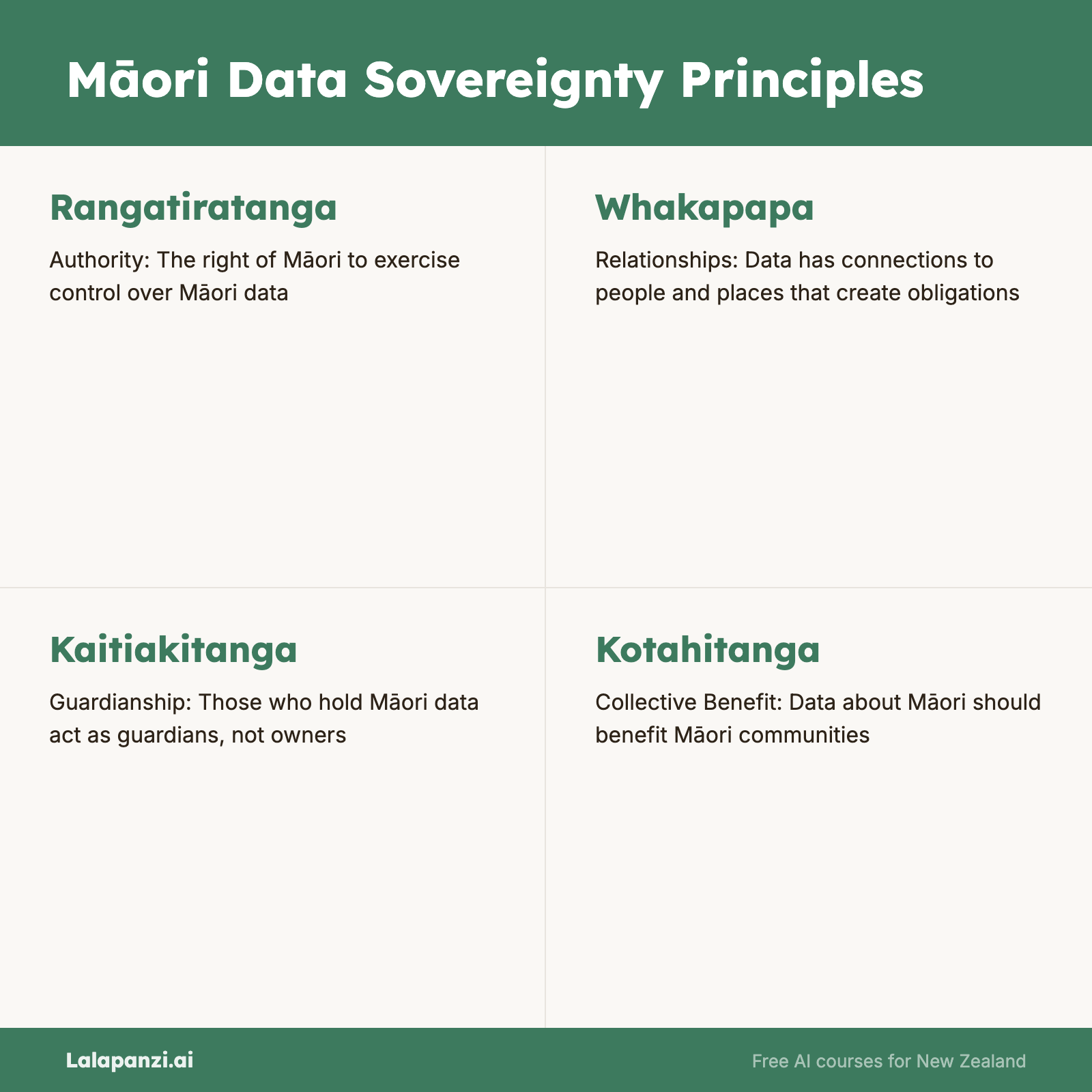
Rangatiratanga (Authority). Māori have the right to exercise control over Māori data, including its creation, collection, access, analysis, interpretation, management, security, dissemination, and reuse.
Whakapapa (Relationships). Data has whakapapa — it comes from somewhere, it connects to people, and those connections create obligations.
Whanaungatanga (Obligations). Those who collect and hold Māori data have reciprocal obligations to the communities that data relates to.
Kotahitanga (Collective benefit). Data about Māori should benefit Māori communities, not just the organisations that collect it.
Manaakitanga (Reciprocity). The collection and use of data should be guided by respect and care for the people it relates to.
Kaitiakitanga (Guardianship). Those who hold Māori data act as guardians, not owners.
Why This Matters for AI
AI systems are voracious consumers of data. Large language models were trained on vast datasets scraped from the internet — including content that contains mātauranga Māori (Māori knowledge), te reo Māori, and data about Māori communities. This raises fundamental questions:
Consent. Was this knowledge shared with the expectation that it would be ingested by AI systems? In almost all cases, no. Mātauranga Māori shared in specific cultural contexts may not have been intended for unrestricted reproduction by AI.
Context. Knowledge in te ao Māori is often contextual — it belongs to particular whānau, hapū, or iwi. It may be sacred, restricted, or appropriate only in certain contexts. AI systems strip away that context, making knowledge universally accessible in ways that may be culturally inappropriate.
Benefit. Who benefits from AI systems that incorporate Māori knowledge and data? If the benefit flows primarily to international tech companies and their shareholders, that's a sovereignty issue.
Accuracy. AI systems often get things wrong, particularly for topics that are less represented in training data. Inaccurate representations of Māori history, tikanga, or te reo can cause genuine harm — spreading misinformation about cultural practices, mangling pronunciation, or perpetuating stereotypes.
Practical Implications
For Organisations
If your organisation operates in Aotearoa, here's what te Tiriti considerations mean for your AI use:
1. Engage early and genuinely. If you're implementing AI systems that will affect Māori communities, engage with those communities from the beginning — not as a checkbox exercise, but as a genuine partnership. This is consistent with the Treaty principle of partnership.
2. Consider data governance. Who controls the data your AI systems use? If it includes data about Māori, consider whether your data governance framework reflects Māori data sovereignty principles. This might involve establishing Māori data governance roles, consulting with iwi or Māori advisors, or using frameworks like He Ara Waiora.
3. Assess equity impacts. Before deploying AI systems, assess whether they serve Māori equitably. Will they worsen existing disparities? Do they work as well for Māori users as for others? Are there cultural considerations in how the system interacts with people?
4. Respect cultural intellectual property. Be cautious about using AI to reproduce, remix, or commercialise elements of Māori culture — including visual motifs, language patterns, traditional knowledge, or cultural narratives. These are not raw material for AI systems to repurpose.
5. Build capability. Supporting Māori participation in the AI sector — through training, employment, and leadership opportunities — is consistent with Te Tiriti obligations and good business practice.
For Individual AI Users
Even at a personal level, you can be thoughtful:
- When AI generates content about Māori topics, verify it carefully. AI often misrepresents or oversimplifies tikanga and mātauranga Māori.
- Don't use AI to generate te reo Māori content unless you can verify its accuracy. AI models frequently make errors with te reo, including incorrect translations, inappropriate usage, and mangled macrons.
- Be mindful of using AI to create content that incorporates Māori cultural elements. If you wouldn't do it without AI, the AI doesn't make it appropriate.
The Broader Context
New Zealand is part of a growing global movement around indigenous data sovereignty. The CARE Principles for Indigenous Data Governance (Collective Benefit, Authority to Control, Responsibility, Ethics) provide an international framework that aligns with Māori data sovereignty principles.
Countries like Australia and Canada are navigating similar questions with their indigenous communities. But Aotearoa's specific context — Te Tiriti, the Waitangi Tribunal process, and the particular relationship between Māori and the Crown — means we need our own approach, not an imported one. The NZ AI Strategy (July 2025) acknowledges this, recognising Te Tiriti obligations and Māori data sovereignty as central to Aotearoa's approach to AI — an important commitment at the national policy level.
Several NZ organisations and researchers are leading work in this space:
- Te Mana Raraunga — the Māori Data Sovereignty Network
- Te Hiku Media — who developed te reo Māori language models with explicit data sovereignty frameworks, ensuring that the data and models remain under Māori control
- The Digital Council for Aotearoa New Zealand (now concluded) made recommendations about AI and indigenous rights
Te Hiku Media's work is particularly notable. When they built a te reo Māori speech recognition tool, they explicitly asserted that the data — recordings of native speakers — belonged to the communities who contributed it, not to any tech company. This model of community-owned AI development is internationally recognised as groundbreaking.
A Note on Humility
If you're not Māori, approaching this topic with humility is essential. You don't need to be an expert in te ao Māori to use AI responsibly — but you do need to recognise the limits of your knowledge, seek guidance when appropriate, and err on the side of respect.
This lesson is an introduction, not a comprehensive guide. For deeper understanding, engage with Māori-led resources, attend relevant wānanga or workshops, and listen to Māori voices in the AI and data sovereignty space.
Key Takeaways
- Te Tiriti o Waitangi's principles of partnership, protection, and equity apply to AI adoption and must be considered by all organisations operating in Aotearoa.
- Indigenous data sovereignty means Māori have the right to govern the collection, ownership, and application of data about their people, territories, and resources.
- AI systems trained on internet data may incorporate mātauranga Māori without consent, raising issues of cultural appropriateness, accuracy, and benefit-sharing.
- Te Hiku Media's community-owned language model is an internationally recognised example of indigenous data sovereignty in practice.
- Approach with humility — verify AI outputs on Māori topics carefully, engage genuinely with Māori communities, and respect cultural intellectual property.
Practical Exercise
Te Tiriti AI Impact Assessment (25 minutes)
- Think about an AI implementation in your workplace or a scenario relevant to your industry (e.g., using AI to analyse customer data, generate marketing content, or automate service delivery).
- Assess this implementation against the following questions:
- Does this AI system use or affect data about Māori communities?
- Have Māori been involved in decisions about how this system is designed or deployed?
- Could this system produce different outcomes for Māori compared to other groups? How would you know?
- Does the system interact with mātauranga Māori, te reo Māori, or Māori cultural elements in any way?
- Who benefits from this system, and are those benefits equitably shared?
- Based on your assessment, write three specific actions your organisation could take to better align its AI use with Te Tiriti principles and Māori data sovereignty.
- Identify one Māori-led resource or organisation (such as Te Mana Raraunga) that you could learn more from.
Knowledge Check
Question 1: Indigenous data sovereignty, as articulated by Te Mana Raraunga, means:
A) The New Zealand government owns all data collected within its borders B) Māori have the right to govern the collection, ownership, and application of data about their people, territories, and resources C) All data must be stored on servers physically located in New Zealand D) Indigenous data should not be digitised
Answer: B — Indigenous data sovereignty is about the rights of indigenous peoples to control data that relates to them. It's about governance and self-determination, not about where servers are located or whether data is digital.
Question 2: Te Hiku Media's approach to developing a te reo Māori speech recognition tool is notable because:
A) They used the largest AI model available B) They explicitly asserted that the data belonged to the communities who contributed it, not to any tech company C) They translated all their data into English first D) They partnered with a major US tech company to build the tool
Answer: B — Te Hiku Media established a model of community-owned AI development, ensuring that recordings of native te reo Māori speakers remained under the control and governance of the contributing communities.
Question 3: You're asked to use AI to create marketing content that incorporates Māori cultural imagery and te reo phrases for a tourism campaign. What should you consider first?
A) Whether the AI can generate accurate te reo — if it can, proceed B) Whether incorporating these cultural elements is appropriate without genuine engagement with Māori, whether the AI will represent them accurately, and whether Māori communities would benefit from or endorse this use C) Whether the campaign will be profitable enough to justify the effort D) Whether other tourism companies have done something similar
Answer: B — Using Māori cultural elements in commercial content raises questions of cultural appropriateness, accuracy, consent, and benefit-sharing. These questions exist regardless of whether AI is involved, but AI can amplify risks through inaccurate or decontextualised representations.
Visual overview