Module 7, Lesson 5: Where NZ Sits Globally and Where the Opportunities Are
Listen to this lesson
Module 7, Lesson 5: Where NZ Sits Globally and Where the Opportunities Are
Estimated reading time: 8 minutes
What You'll Learn
This final lesson zooms out. Where does New Zealand sit in the global AI landscape? What are our genuine advantages and disadvantages? And — most importantly — where are the real opportunities for NZ businesses and professionals? Not hype. Not wishful thinking. A clear-eyed assessment of where we are and where we could go.
NZ's Global Position: An Honest Assessment
Let's be straight about it: New Zealand is not going to compete with the United States, China, or the EU on AI research and development. We don't have the population, the capital, or the concentration of AI talent to build the next frontier model. That's fine. We don't need to.
New Zealand's AI opportunity isn't about building the technology. It's about applying it — thoughtfully, creatively, and in ways that play to our strengths.
Where We Rank
Various global AI indices place New Zealand in the middle of the pack among developed nations. We score well on:
- Government readiness — relatively progressive policy settings, the Algorithm Charter, the NZ AI Strategy (July 2025), the Public Service AI Framework, and an engaged Privacy Commissioner. The government's light-touch, principles-based approach aims to remove barriers to adoption while aligning with OECD AI principles.
- Digital infrastructure — good (though not universal) broadband coverage, high smartphone penetration
- Education levels — a well-educated population with strong digital literacy foundations
- Innovation culture — the number 8 wire mentality translates well to creative AI application
We score less well on:
- AI research output — limited compared to larger nations with more research funding
- AI talent pool — a small and competitive market for AI specialists
- Venture capital — less investment capital available for AI startups compared to the US, UK, or Singapore
- Scale — a domestic market of 5 million people limits the economics of AI-first products built solely for NZ
Notably, recent independent modelling from Microsoft suggests that AI could unlock a massive economic boost of up to $102 billion for the New Zealand economy by 2038. This underscores the scale of the opportunity and the urgency for local businesses and professionals to integrate these tools effectively.
The Stanford AI Index
The Stanford University AI Index — one of the most comprehensive global reports on AI — tracks country-level adoption and investment. New Zealand rarely features prominently in these rankings, which are dominated by the US, China, UK, Canada, and the EU. But this isn't necessarily bad news. It simply reflects that our opportunity lies in application, not in fundamental research.
New Zealand's Aotearoa Agentic AI Platform Initiative
In early 2026, MBIE (Ministry of Business, Innovation and Employment) launched the Aotearoa Agentic Artificial Intelligence Platform (AAAIP) — a national initiative to augment New Zealand's 5 million people with 100 million AI assistants. This ambitious programme aims to create a "wealthier and fairer country" through widespread agentic AI deployment across the economy. The AAAIP's primary objective is to shift NZ from being a passive consumer of AI to an active orchestrator of agentic workflows.
The AAAIP represents a significant commitment from government to position NZ at the forefront of practical AI adoption. Rather than competing on model development, New Zealand is doubling down on application — using agentic AI systems to boost productivity, improve service delivery, and enhance economic competitiveness. The AAAIP's vision of augmenting 5 million people with 100 million assistants highlights a shift from passive consumption to active orchestration of agentic workflows. For businesses and professionals, this means:
- Government investment in AI infrastructure that private sector can leverage
- A national framework for responsible agentic AI deployment
- Opportunities for partnerships between public and private sectors
- Growing domestic demand for AI skills and expertise
This initiative signals that New Zealand is treating AI as an economic imperative — not just a technology trend. For organisations planning their AI strategy, understanding AAAIP's goals and how they align with your sector can reveal collaborative opportunities and funding pathways.
The EU AI Act: What NZ Businesses Need to Know
While New Zealand has taken a light-touch approach to AI regulation, other jurisdictions are moving faster. The EU AI Act's transparency obligations took effect on 2 August 2026, and they apply to any organisation whose AI-generated content reaches EU audiences. Key requirements:
- Chatbots must identify themselves as AI from the first interaction.
- Deepfakes must be labelled as artificially generated or manipulated content.
- AI-generated text on topics of public interest must be marked as AI-produced.
- Emotion recognition and biometric categorisation systems must disclose their use.
For NZ businesses exporting to or operating in European markets, this means your AI-generated marketing content, customer service chatbots, and any AI-assisted media may need to comply with these labelling requirements. Even businesses not directly affected should take note — the EU rules are setting a global benchmark, and customer expectations around AI transparency are rising everywhere. The safest approach for NZ businesses is to adopt voluntary transparency practices now: label AI-generated content, disclose chatbot use, and be upfront about AI involvement in customer-facing outputs.
NZ's Genuine Advantages
Small doesn't mean disadvantaged. New Zealand has several characteristics that could be significant advantages in the AI era:
1. Agility
Small countries and small organisations can move fast. While large nations debate AI regulation for years, NZ can adapt quickly. The publication of the NZ AI Strategy in July 2025 is a good example — it set out the government's approach to safe and responsible AI adoption, building AI capability across the economy, and positioning NZ to benefit from AI, all within a relatively compact timeframe. Our regulatory framework, while still developing, can evolve more rapidly than in larger, more complex jurisdictions. NZ businesses — most of which are SMEs — can adopt and integrate AI tools without the bureaucratic overhead of large corporations.
2. Trust and Reputation
New Zealand consistently ranks among the most trusted and least corrupt countries in the world. In an era where AI raises significant trust concerns — around data handling, ethical use, and transparency — NZ businesses and institutions start from a strong trust baseline. "Built in New Zealand" carries weight when it comes to data ethics and responsible technology.
3. Primary Sector Expertise
Few countries know agriculture like New Zealand. We have deep expertise in dairy, horticulture, viticulture, forestry, and fisheries. AI applications in these sectors — precision agriculture, supply chain optimisation, sustainability monitoring, biosecurity — are areas where NZ can lead globally. We're not just applying AI to farming; we're applying AI to farming that we understand better than almost anyone.
4. Unique Cultural Context
Te Tiriti o Waitangi and our bicultural framework create a unique context for thinking about AI ethics, data sovereignty, and inclusive technology development. Work by organisations like Te Mana Raraunga and Te Hiku Media positions New Zealand as a global thought leader on indigenous data sovereignty. This isn't just an internal consideration — it's an exportable framework that other countries with indigenous populations are looking to learn from.
5. Quality of Life
This sounds soft, but it matters for talent. New Zealand's quality of life, natural environment, and relative safety make it an attractive place for skilled professionals. As remote work becomes more normalised, NZ's ability to attract and retain global talent improves — even if we can't match Silicon Valley salaries.
Where the Opportunities Are
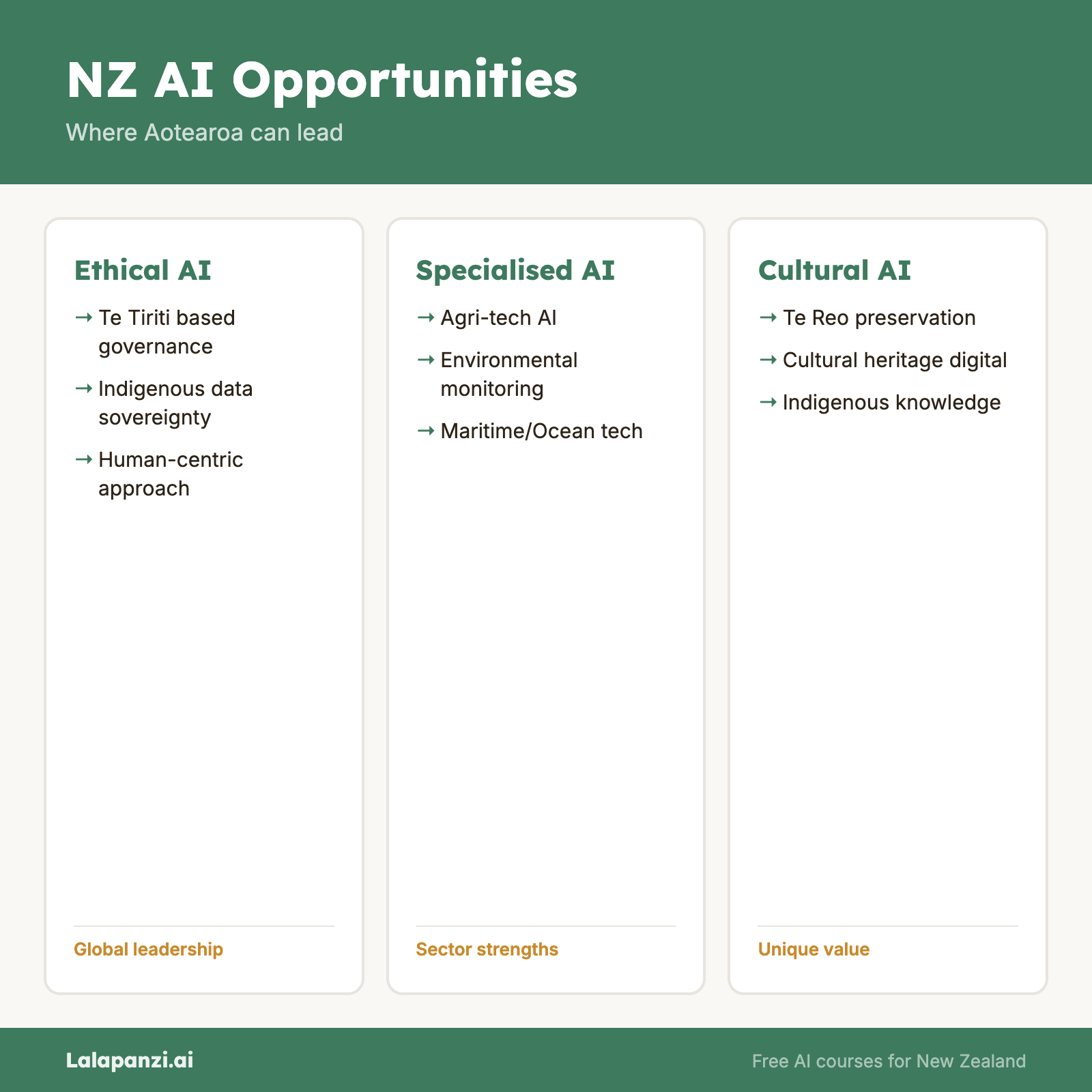
Based on our strengths and the current trajectory of AI development, here are the areas where NZ has genuine competitive opportunities:
AgriTech AI
This is arguably NZ's single biggest AI opportunity. Combining our agricultural expertise with AI capabilities to develop tools for precision farming, environmental monitoring, food safety, and supply chain optimisation — not just for NZ but for export to agricultural economies worldwide. Companies like Halter, Hectre, and LIC are already showing what's possible.
AI-Powered Professional Services
NZ's strong professional services sector — law, accounting, consulting, engineering — is well-positioned to integrate AI deeply. Firms that develop AI-enhanced service delivery models can improve efficiency, reduce costs, and potentially export those models to similar markets (Australia, UK, Singapore). The opportunity isn't just using AI tools — it's becoming genuinely excellent at applying them in professional contexts.
Healthcare AI Application
With Health New Zealand (Te Whatu Ora) centralising the health system, there's an opportunity to implement AI at scale in ways that smaller, fragmented health systems can't. AI-assisted diagnostics, predictive health modelling, and administrative automation could help address NZ's healthcare workforce challenges — if implemented thoughtfully and equitably.
Government and Public Sector AI
NZ's Algorithm Charter signals a willingness to use AI in government. Well-implemented government AI — for service delivery, policy analysis, and operational efficiency — could make NZ a model for other small nations. The key is doing it transparently and building public trust.
Indigenous Data Sovereignty and Ethical AI
NZ has an opportunity to be a global leader in ethical AI development — particularly around indigenous data sovereignty, community-owned AI models, and culturally responsive technology. This is an area where our unique context is a genuine competitive advantage. International organisations and governments are already looking to NZ (and specifically to Māori-led initiatives) for guidance.
AI Education and Training
Here's a meta-opportunity: as AI adoption grows globally, so does the need for practical, accessible AI training. NZ-based AI education — grounded in our values of accessibility, honesty, and practical application — can serve not just the domestic market but the broader English-speaking world. (This is exactly what Lalapanzi.ai will offer — practical, grounded AI education for the real world.)
What Individual Professionals Should Do
Regardless of your industry or role, here are practical steps to position yourself well in NZ's AI future:
1. Build your AI literacy now. You're doing this by taking this course. Continue learning, experimenting, and staying current. The skills gap is real, and people who understand AI will be in demand.
2. Apply AI to your domain expertise. The most valuable AI users aren't AI specialists — they're domain experts who know how to use AI. If you're a nurse, a farmer, a lawyer, an accountant, a teacher — your professional knowledge combined with AI capability is more valuable than either alone.
3. Think about your industry's opportunities. Every sector has tasks that AI can improve. Identify them in your own work, experiment, and share what you learn with colleagues.
4. Engage with the NZ AI community. Join the AI Forum NZ, attend local meetups, follow NZ AI researchers and practitioners on social media. The community is small enough that you can genuinely connect with the people shaping NZ's AI future.
5. Think global, act local. NZ's domestic market is small, but our expertise — in agriculture, sustainability, ethical AI, indigenous data sovereignty — is globally relevant. Whatever you build or learn, think about how it scales beyond our borders.
The Bottom Line
New Zealand won't build the next GPT. We don't need to. Our opportunity is to be among the best in the world at applying AI — thoughtfully, ethically, and in ways that reflect who we are. A small, innovative, high-trust country with deep domain expertise, a unique cultural context, and a population that's genuinely good at figuring things out.
The AI wave is here. The question isn't whether it will reach Aotearoa — it already has. The question is whether we'll ride it with intention or get swept along by default.
This course has given you the fundamentals. What you do with them is up to you.
Key Takeaways
- NZ won't compete on AI research or model development, but we can be world-leading in AI application — particularly in agriculture, professional services, healthcare, and ethical AI.
- Our genuine advantages include agility, international trust, primary sector expertise, unique cultural context (Te Tiriti, indigenous data sovereignty), and quality of life for talent.
- AgriTech AI is arguably NZ's single biggest AI opportunity, combining deep agricultural expertise with AI capabilities for both domestic and export markets.
- NZ can be a global leader in ethical and indigenous AI, building on work by Te Mana Raraunga, Te Hiku Media, and the Algorithm Charter.
- Individual professionals should build AI literacy, apply it to their domain expertise, and engage with the NZ AI community.
Practical Exercise
Your AI Action Plan (30 minutes)
This is the capstone exercise for the entire course. Create a personal AI action plan:
- Current state: How are you currently using AI? (Be specific — list the tools and tasks)
- Opportunities: Identify three specific ways you could use AI more effectively in your work or personal life over the next three months.
- Skills to develop: Based on what you've learned in this course, what are the two or three areas where you most need to grow? (Prompt engineering? Verification habits? Understanding privacy obligations? Industry-specific applications?)
- Resources: Identify two resources you'll use to continue learning. (AI Forum NZ, specific blogs, communities, courses, tools to experiment with)
- One commitment: Write down one specific thing you will do in the next week to put your AI learning into practice.
Keep this plan somewhere you'll see it. Review it in three months and see how far you've come.
Knowledge Check
Question 1: What is New Zealand's primary AI opportunity, according to this lesson?
A) Building the next frontier AI model to compete with OpenAI and Google B) Applying AI thoughtfully and creatively, drawing on our strengths in agriculture, professional services, trust, and ethical AI C) Banning AI to protect jobs and privacy D) Recruiting all the world's AI researchers to move to New Zealand
Answer: B — NZ's opportunity lies in application, not fundamental research. Our strengths — agricultural expertise, high-trust reputation, agility, and unique cultural context — position us well to be leaders in applying AI thoughtfully.
Question 2: Why is AgriTech AI considered one of NZ's biggest opportunities?
A) Because New Zealand has more farms than any other country B) Because NZ has deep agricultural expertise that, combined with AI capabilities, can create tools for both domestic use and global export C) Because AI can completely replace farm workers D) Because the NZ government has mandated AI use in agriculture
Answer: B — NZ's combination of world-class agricultural knowledge and growing AI capability creates an opportunity to develop AgriTech AI solutions that serve both the domestic market and agricultural economies globally.
Question 3: Which of the following is NOT listed as a genuine NZ advantage in the AI era?
A) Agility — small countries and businesses can adapt quickly B) The largest AI research budget in the Southern Hemisphere C) International trust and reputation for ethical practice D) Unique cultural context including Te Tiriti and indigenous data sovereignty leadership
Answer: B — NZ does not have a large AI research budget compared to major nations. Our advantages lie in agility, trust, primary sector expertise, cultural context, and quality of life — not in research funding or scale.
Visual overview