Module 7, Lesson 3: Industry-Specific AI Applications in NZ
Listen to this lesson
Module 7, Lesson 3: Industry-Specific AI Applications in NZ
Estimated reading time: 9 minutes
What You'll Learn
AI isn't one-size-fits-all, and neither is New Zealand's economy. This lesson looks at how AI is being used — and where it could be used — across four key sectors of the NZ economy: agriculture, healthcare, the public sector, and professional services. These aren't theoretical possibilities. Many of these applications are happening right now, and understanding them helps you see where the opportunities are in your own industry.
Agriculture and Primary Industries
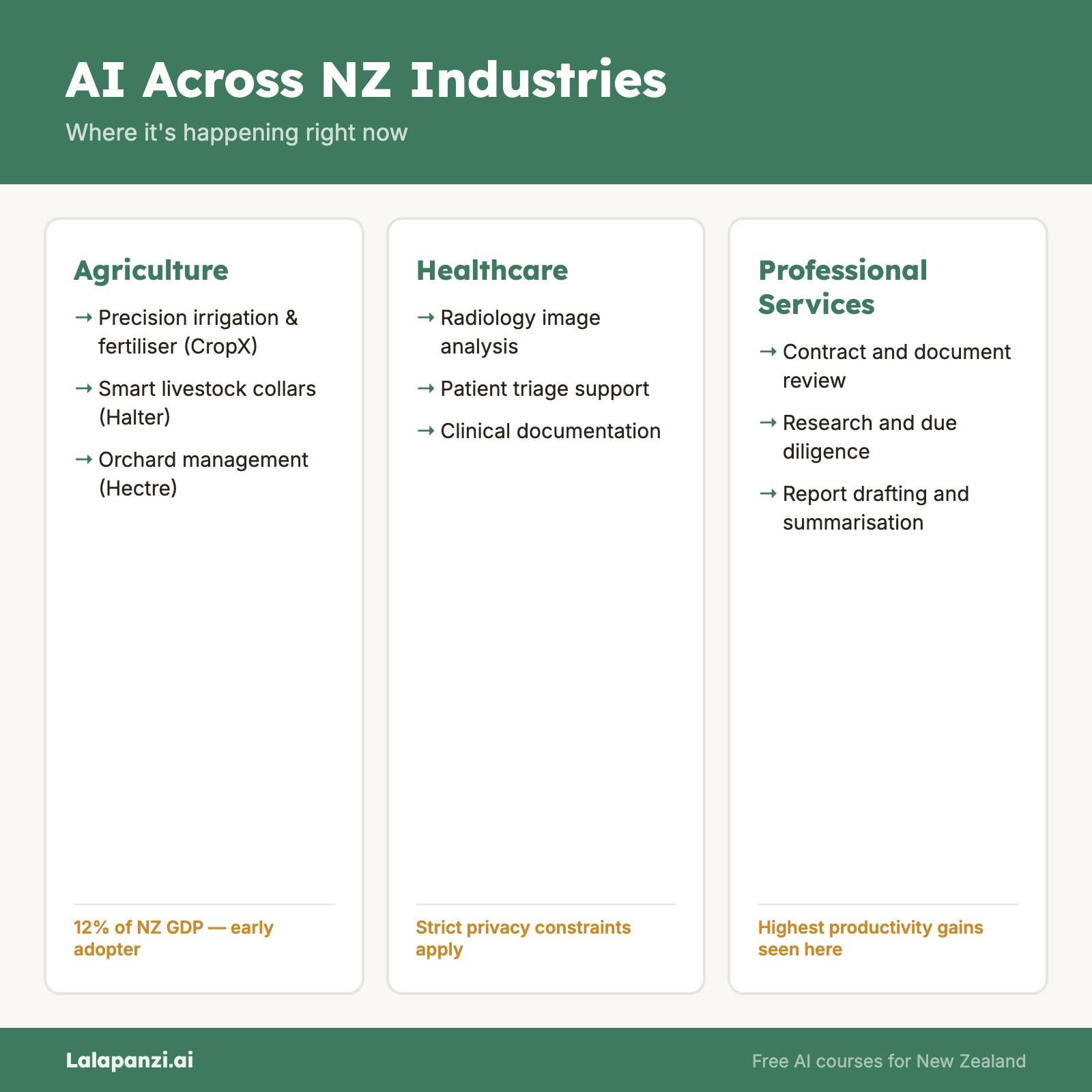
Agriculture is the backbone of the New Zealand economy, contributing around 12% of GDP when you include the wider food and fibre sector. It's also a sector where AI has genuine, practical applications that go beyond the hype.
What's Happening Now
Precision agriculture. AI-powered tools are helping farmers make better decisions about irrigation, fertiliser application, and pest management by analysing data from sensors, satellites, and weather stations. Companies like CropX and Hectre (a NZ-based company) are using AI to optimise orchard management and post-harvest logistics.
Animal health monitoring. AI systems can analyse data from sensors on livestock to detect early signs of illness, lameness, or distress. Halter, a New Zealand company, has developed GPS-enabled smart collars for dairy cattle that use AI to monitor behaviour and manage herd movement without physical fences.
Environmental compliance. With increasing regulatory requirements around freshwater quality, emissions reporting, and biodiversity, AI tools can help farmers monitor and report on environmental metrics more efficiently.
Supply chain optimisation. From farm to port to international markets, AI is being used to optimise logistics, predict demand, and reduce waste in New Zealand's agricultural export supply chains.
The Opportunity
New Zealand's agricultural reputation is built on quality and sustainability. AI tools that help farmers produce more with less environmental impact align perfectly with this positioning. The challenge is connectivity — many farms lack the reliable internet access that cloud-based AI tools require. Edge computing (running AI locally on devices rather than in the cloud) and improving rural broadband are part of the solution.
Healthcare
Healthcare in New Zealand faces persistent challenges: workforce shortages, growing demand, and the need to provide equitable access across a geographically dispersed population. AI offers some genuine opportunities to help — alongside some risks that need careful management.
What's Happening Now
Medical imaging. AI tools that help radiologists analyse X-rays, CT scans, and MRIs are among the most mature healthcare AI applications. These tools don't replace radiologists — they flag areas of concern, help prioritise urgent cases, and catch things that might be missed in high-volume environments. Some NZ district health boards (now part of Health New Zealand – Te Whatu Ora) have been piloting AI-assisted imaging tools.
Administrative efficiency. Healthcare generates enormous amounts of paperwork. AI tools for clinical documentation, appointment scheduling, referral management, and coding can free up clinical staff to focus on patient care. Given NZ's healthcare workforce pressures, this is a significant opportunity.
Telehealth and triage. AI-powered symptom checkers and triage tools can help direct patients to the right level of care, reducing unnecessary emergency department visits. Several NZ-based telehealth providers have explored AI-assisted triage.
Mental health. With significant demand for mental health services and limited access, AI chatbots designed for mental health support (like Woebot or similar tools) offer a way to provide initial support and psychoeducation, though they're not a replacement for professional clinical care.
The Considerations
Healthcare AI in NZ must navigate:
- Health Information Privacy Code 2020, which sets specific rules for health information that go beyond the general Privacy Act
- Clinical safety — any AI tool used in clinical decision-making needs rigorous validation
- Equity — AI tools trained primarily on data from other countries may not perform as well for Māori and Pacific populations, who have different health profiles and may be under-represented in training data
- Te Tiriti obligations — the health system has specific obligations under Te Tiriti o Waitangi, including supporting Māori health outcomes and Māori data sovereignty (more on this in Lesson 4)
Public Sector
The New Zealand public sector is a significant employer and service provider, and it's approaching AI with a combination of interest and appropriate caution.
What's Happening Now
The Algorithm Charter for Aotearoa New Zealand. In 2020, the NZ Government published an Algorithm Charter committing government agencies to use algorithms (including AI) in a way that is transparent, accountable, and fair. While not legally binding, it signals the government's awareness that algorithmic decision-making needs oversight. The government built on this foundation with the NZ AI Strategy (July 2025), which sets out a broader approach to AI adoption across the economy, including supporting sector-specific AI use in areas like health, agriculture, and the public sector.
Service delivery. Government agencies are exploring AI to improve service delivery — from chatbots on government websites to AI-assisted processing of applications and forms. The Department of Internal Affairs, IRD, and MSD have all explored or implemented AI-assisted tools in various capacities.
Policy analysis. AI tools can help policy analysts process large volumes of public submissions, research, and data. This doesn't replace human judgement in policy-making, but it can speed up the evidence-gathering phase.
Operational efficiency. Like any large organisation, government agencies use AI for internal functions — IT support, document management, communications, and procurement.
The Considerations
Public sector AI use faces additional scrutiny:
- Transparency and accountability — citizens have a right to understand how decisions affecting them are made
- The Official Information Act 1982 — decisions made with AI assistance may be subject to OIA requests
- Equity — government services must be accessible and fair to all New Zealanders. AI systems that perform differently for different demographic groups are a serious concern
- Public trust — government AI use is subject to public debate and media scrutiny. Getting it wrong has political as well as operational consequences
Professional Services
Law, accounting, consulting, financial advice, engineering — New Zealand's professional services sector employs a significant portion of the workforce, and AI is increasingly relevant across all of these fields.
What's Happening Now
Legal. NZ law firms are using AI for legal research, document review, contract analysis, and first-draft document preparation. Large firms like Russell McVeagh and Chapman Tripp have been public about exploring AI tools. However, lawyers remain responsible for the accuracy of their work, and the NZ Law Society has issued guidance on AI use in legal practice.
Accounting. Firms use AI for data extraction from receipts and invoices, anomaly detection in financial data, and automating routine compliance tasks. Xero, a NZ-founded company, continues to integrate AI features into its accounting platform.
Financial advice. AI tools can assist with data analysis and scenario modelling, but the Financial Markets Authority (FMA) has emphasised that personalised financial advice must involve human judgement and comply with existing regulatory requirements.
Engineering and architecture. AI-assisted design tools, structural analysis, and project management are gaining traction. Building Information Modelling (BIM) platforms are increasingly incorporating AI features.
The Common Thread
Across all professional services, a consistent pattern emerges: AI excels at the research, analysis, and first-draft stages, while human expertise remains essential for judgement, client relationships, ethical considerations, and final decision-making. The professionals who thrive will be those who use AI to handle the volume work, freeing them to focus on the high-value thinking.
What This Means for You
Regardless of your industry, the AI applications in your sector are likely already emerging — even if they're not always labelled as "AI." The question isn't whether AI will affect your work. It's whether you'll be proactive about understanding and shaping how it's used, or reactive.
Start by looking at the repetitive, data-heavy, and time-consuming parts of your work. That's where AI delivers the most immediate value. Then think about the higher-value applications — better decision-making, deeper analysis, improved outcomes — that become possible once the routine work is handled more efficiently.
Key Takeaways
- Agriculture is using AI for precision farming, animal health monitoring, and supply chain optimisation, with NZ companies like Halter and Hectre leading innovation.
- Healthcare AI applications include medical imaging, administrative efficiency, and telehealth, but must navigate health-specific privacy rules and equity considerations.
- The public sector has committed to transparent, accountable AI use through the Algorithm Charter, with applications in service delivery and policy analysis.
- Professional services use AI for research, document review, and data analysis, while maintaining human responsibility for judgement and advice.
- Across all sectors, AI handles volume and routine work, freeing people for high-value thinking and decision-making.
Practical Exercise
Industry AI Opportunity Map (25 minutes)
- Choose your own industry (or one you're interested in).
- Create a simple three-column table:
| Task / Process | AI Could Help By... | Considerations / Risks |
|---|
- List at least five specific tasks or processes in your industry.
- For each, describe how AI could assist and identify at least one consideration or risk.
- Rank your five items by potential impact (which would save the most time, improve quality the most, or create the most value?).
- Identify the single best place to start and write a brief justification for why.
Knowledge Check
Question 1: Halter, mentioned in the lesson, is a New Zealand company that uses AI for:
A) Automated financial reporting for dairy farms B) GPS-enabled smart collars for dairy cattle that monitor behaviour and manage herd movement C) Translating farm data into te reo Māori D) Predicting milk prices on international markets
Answer: B — Halter develops GPS-enabled smart collars for dairy cattle that use AI to monitor animal behaviour and enable virtual fencing, allowing farmers to manage herd movement without physical fences.
Question 2: Why is equity a particular concern for healthcare AI in New Zealand?
A) Because NZ healthcare is entirely privately funded B) Because AI tools trained primarily on overseas data may not perform as well for Māori and Pacific populations, who may be under-represented in training data C) Because New Zealand doctors refuse to use technology D) Because the Privacy Act doesn't apply to healthcare
Answer: B — AI models trained predominantly on data from other populations may not accurately reflect the health profiles and needs of Māori and Pacific peoples. This creates a risk that AI-assisted healthcare could worsen existing health inequities rather than improving them.
Question 3: The Algorithm Charter for Aotearoa New Zealand is:
A) A legally binding regulation that prohibits government agencies from using AI B) A government commitment to transparent, accountable, and fair use of algorithms, including AI, in public sector decision-making C) A technical standard for how AI code must be written in New Zealand D) A private sector agreement between NZ tech companies
Answer: B — Published in 2020, the Algorithm Charter is a government commitment (not legally binding) that sets expectations for how government agencies should use algorithms and AI — emphasising transparency, accountability, and fairness.
Visual overview