Module 6, Lesson 3: Copyright and Intellectual Property Considerations
Listen to this lesson
Module 6, Lesson 3: Copyright and Intellectual Property Considerations
Estimated reading time: 8 minutes
What You'll Learn
AI has created a genuinely new set of questions around copyright and intellectual property (IP). Who owns what an AI generates? Can you use AI-generated content commercially? What about the data AI was trained on — did anyone get permission to use it? These questions don't have simple answers yet, but understanding the landscape will help you make better decisions about how you use AI in your work.
The Two Sides of the Copyright Question
When it comes to AI and copyright, there are two distinct issues that often get tangled together:
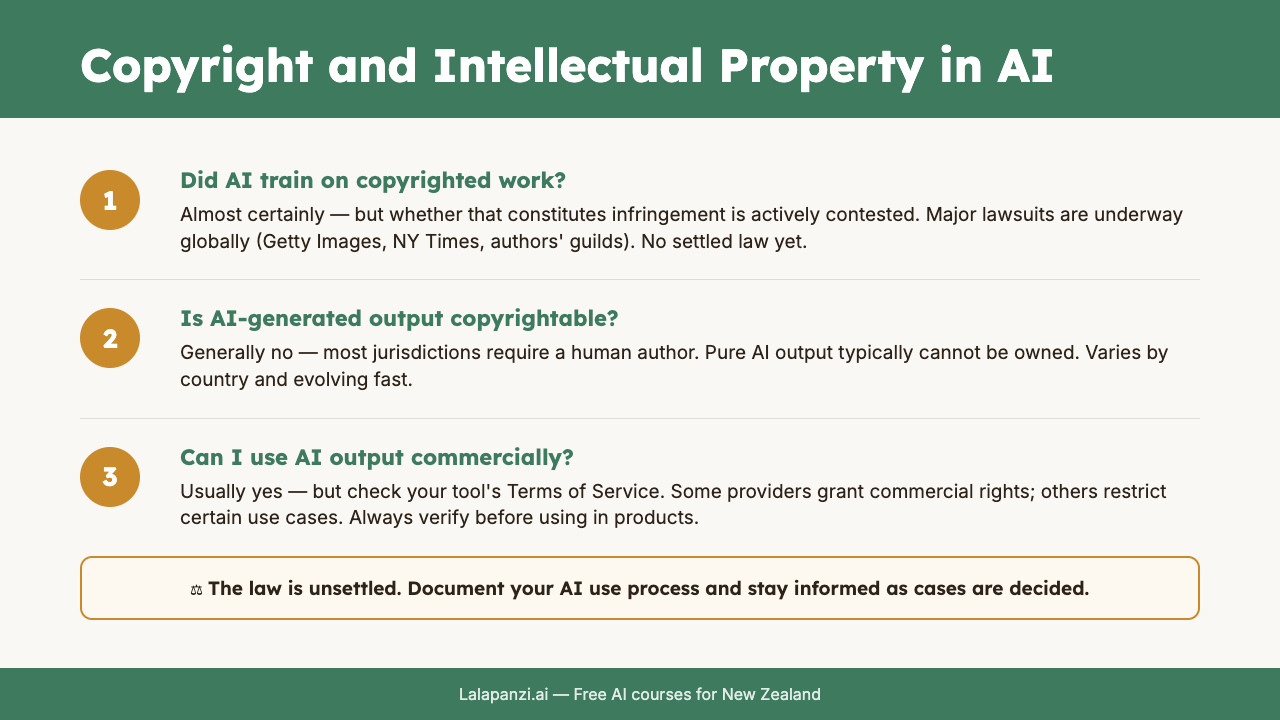
1. Input: Was copyrighted material used to train the AI without permission? 2. Output: Who owns the content that AI generates?
Let's look at each.
The Input Problem: Training Data
Large language models are trained on enormous datasets scraped from the internet. This includes news articles, blog posts, books, academic papers, code repositories, social media posts, and much more. Much of this content is copyrighted.
The AI companies argue that using this data for training constitutes "fair use" (in US law) or falls under similar exceptions in other jurisdictions. Many content creators disagree. Several major lawsuits are currently working through the courts:
- The New York Times sued OpenAI and Microsoft, alleging that their models reproduce substantial portions of copyrighted articles.
- Authors including Sarah Silverman and Michael Chabon have filed suits against AI companies over the use of their books in training data.
- Getty Images sued Stability AI over the use of millions of copyrighted photographs to train image generators.
As of early 2026, these cases are still being litigated. No definitive legal precedent has been established in most jurisdictions. The law is genuinely unsettled.
What this means for you: You're not directly responsible for how AI models were trained. But it's worth being aware that the tools you're using may have been built on a foundation that courts eventually rule was improperly assembled. Keep an eye on developments — the outcomes could affect what tools are available and how they operate.
The Output Problem: Who Owns AI-Generated Content?
This is the question most people care about practically: if I use AI to help me write something, who owns it?
The answer depends on where you are and how much the AI contributed.
The General Principle
In most jurisdictions, copyright requires human authorship. A purely AI-generated work — one where a human simply typed "write me a poem about Wellington" and published whatever came back — is unlikely to be copyrightable. The US Copyright Office has been explicit about this: works generated by AI without meaningful human creative input cannot be registered for copyright.
However, the picture gets murkier when humans are involved in the creative process. If you use AI to generate a first draft and then substantially edit, restructure, and refine it, the resulting work likely does have copyright protection — because of your human creative contribution.
New Zealand's Position
New Zealand copyright law is governed by the Copyright Act 1994. Interestingly, NZ law includes a provision for computer-generated works. Section 5(2)(a) states that for a computer-generated work, the author is "the person by whom the arrangements necessary for the creation of the work are undertaken."
This is unusual — most countries don't have an equivalent provision. It could be interpreted to mean that the person who prompted the AI is the author of the resulting work. However, this section was written long before modern generative AI existed, and it hasn't been tested in court in this context. It would be unwise to rely on it without legal advice.
Practical Guidance
Until the law catches up — and that could take years — here's a sensible approach:
1. Don't publish raw AI output as your own original work. Beyond the legal questions, it's simply not good practice. AI output benefits enormously from human editing, fact-checking, and refinement.
2. Add genuine human creativity. The more you shape, edit, and transform AI-generated content, the stronger your claim to the final work. Use AI as a starting point, not an endpoint.
3. Be transparent when it matters. In academic, journalistic, and professional contexts, disclosure of AI assistance is increasingly expected. Many publishers, universities, and professional bodies now have explicit policies on this.
4. Don't use AI to reproduce copyrighted works. Asking an AI to "rewrite this article in different words" or "generate something in the style of [specific author]" with the intent to replicate their copyrighted work is ethically and potentially legally problematic.
Intellectual Property Beyond Copyright
Copyright is the most discussed IP issue with AI, but it's not the only one.
Trade Secrets
If you paste proprietary business information into an AI tool, you may be compromising trade secret protection. Trade secret law generally requires that you take reasonable steps to keep the information secret. Sharing it with a third-party AI provider — especially one that may use your inputs for training — could undermine that protection.
Trademarks
AI tools can inadvertently generate content that includes or imitates trademarked names, logos, or phrases. If you're using AI to create marketing materials, brand content, or product descriptions, review the output for any trademark issues before publishing.
Patents
The question of whether AI can be listed as an inventor on a patent has been tested in courts worldwide. The consensus so far: no. Patents require a human inventor. If you use AI to help develop an invention, the human contributors are the inventors.
What Organisations Should Consider
If your workplace uses AI tools, these IP considerations should be part of your AI usage policy:
- Ownership of outputs. Clarify who owns content generated with AI assistance — the individual, the organisation, or neither?
- Disclosure requirements. When should AI use be disclosed to clients, customers, or stakeholders?
- Input restrictions. What company IP (trade secrets, proprietary data, unpublished research) should not be entered into AI tools?
- Review processes. Who checks AI-generated content for potential IP issues before it's published or shared externally?
The Evolving Landscape
This is one area where the law is genuinely playing catch-up with technology. Governments worldwide are working on AI-specific legislation and regulations. The EU's AI Act, various US state and federal frameworks (the 2023 Executive Order on AI was rescinded in early 2025), and various national frameworks are all addressing these questions in different ways.
In New Zealand, according to available information, the government has been relatively measured in its approach — monitoring international developments rather than rushing to legislate. This means NZ businesses need to be proactive about managing IP risk rather than waiting for clear regulatory guidance.
The most important thing you can do is stay informed. The rules are being written in real time, and what's acceptable practice today may not be tomorrow — and vice versa.
Key Takeaways
- Copyright law around AI is unsettled. Major lawsuits are ongoing, and no definitive precedent exists in most jurisdictions.
- Purely AI-generated content probably isn't copyrightable in most countries, but content with substantial human creative input likely is.
- NZ's Copyright Act 1994 has a provision for computer-generated works that could be relevant, but it hasn't been tested with modern AI.
- Don't paste trade secrets or proprietary IP into AI tools — it could compromise your legal protections.
- Add genuine human creativity to AI outputs, be transparent about AI use, and stay informed as the law evolves.
Practical Exercise
IP Risk Assessment (20 minutes)
- Think about the last five times you used an AI tool for work or a project.
- For each instance, consider:
- Did you input any proprietary or confidential information?
- Did you use the AI output without significant modification?
- Would a reasonable person know that AI was involved in creating the final product?
- Could the output contain elements that infringe on someone else's copyright or trademark?
- Based on your assessment, write three practical rules you would follow going forward to manage IP risk when using AI tools.
- Bonus: Check whether your workplace or professional body has an AI usage policy that addresses IP. If not, note this as something worth raising.
Knowledge Check
Question 1: You use ChatGPT to generate a 500-word blog post and publish it without any editing. In most jurisdictions, what is the likely copyright status of that content?
A) You own full copyright because you wrote the prompt B) OpenAI owns the copyright because their model generated it C) The content is likely not copyrightable because it lacks sufficient human creative input D) Copyright automatically belongs to whoever publishes content first
Answer: C — Most jurisdictions require human authorship for copyright. A prompt alone is generally not considered sufficient creative input. The content exists in a legal grey area and likely cannot be registered for copyright protection.
Question 2: You paste your company's unpublished product roadmap into an AI tool to help you create a summary presentation. What is the primary intellectual property risk?
A) The AI might patent your product ideas B) You may compromise your company's trade secret protection by sharing confidential information with a third party C) The AI will sell your roadmap to competitors D) There is no risk because AI tools are confidential
Answer: B — Trade secret protection requires reasonable efforts to maintain secrecy. Sharing confidential business information with a third-party AI provider — especially one that may store or use your inputs — could weaken that protection.
Question 3: New Zealand's Copyright Act 1994 includes a provision for computer-generated works. What does this provision say about authorship?
A) Computer-generated works cannot be copyrighted in New Zealand B) The AI itself is considered the author C) The person who made the arrangements necessary for the creation of the work is considered the author D) Computer-generated works are automatically in the public domain
Answer: C — Section 5(2)(a) of the Copyright Act 1994 states that for computer-generated works, the author is the person by whom the arrangements necessary for creation were undertaken. However, this hasn't been tested with modern generative AI.
Visual overview