Lesson 1: Platforms vs Models — Why ChatGPT Isn't "One AI"
Listen to this lesson
Lesson 1: Platforms vs Models — Why ChatGPT Isn't "One AI"
Course: Choosing the Right AI Model (Personal Pathway, Free) Estimated reading time: 8 minutes Last updated: 2026-07-14
The Biggest Misconception in AI Right Now
If someone asked you "What AI do you use?", you'd probably say "ChatGPT." Fair enough — it's the one everyone knows. But here's the thing: ChatGPT isn't an AI model. It's a platform. And behind that platform are several very different AI models, each with different strengths, speeds, and price tags.
This distinction matters more than most people realise. It's the difference between saying "I drive a Toyota" and "I drive a car." Knowing the specific model changes everything about what you can expect.
What's a Platform? What's a Model?
Let's make this concrete.
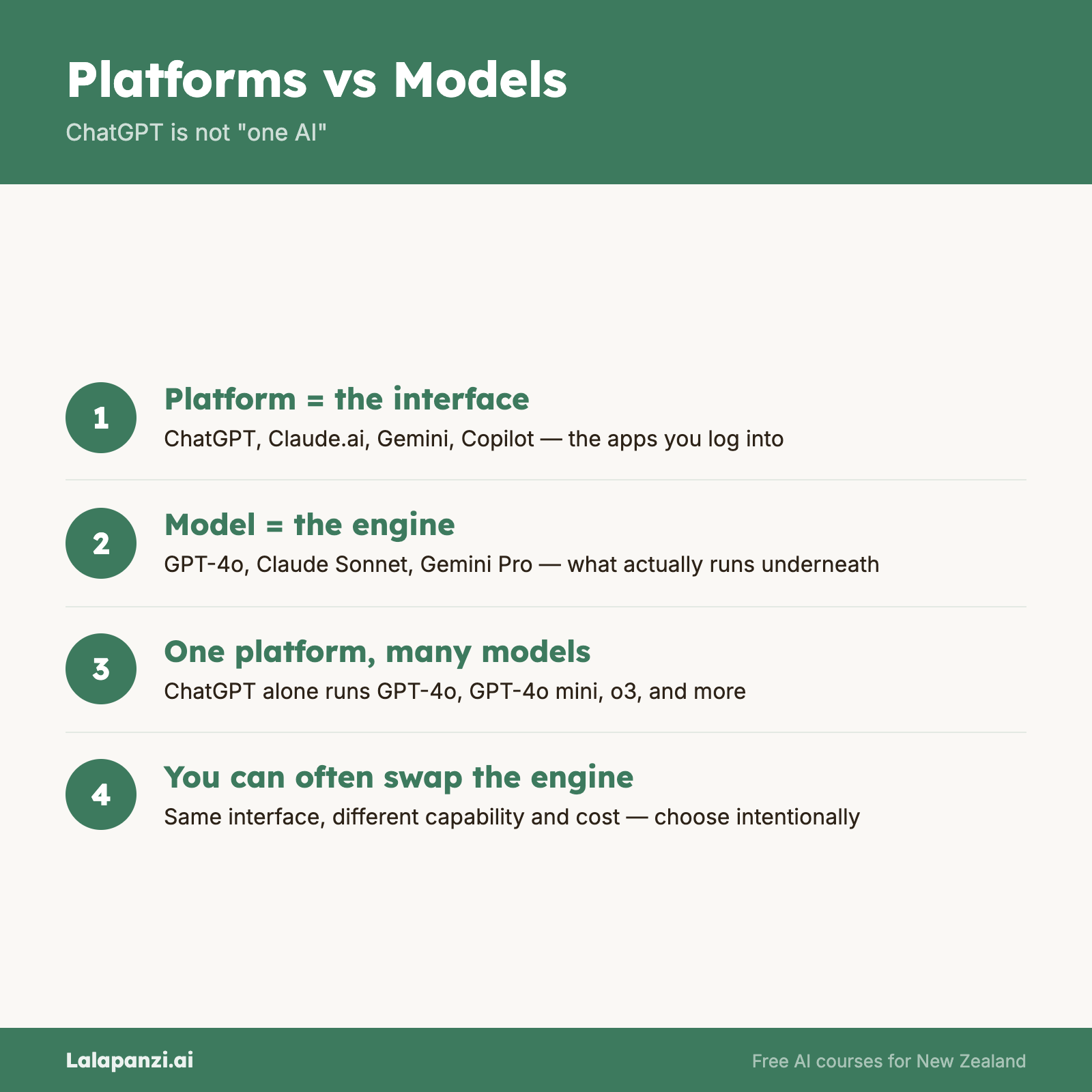
A platform is the website or app you interact with. ChatGPT, Claude, Gemini, Copilot — these are platforms. They're the interface: the chat window, the buttons, the settings. Think of a platform like a restaurant. You walk in, sit down, and order from the menu.
A model is the AI engine running behind that platform. GPT-5.6, Claude Sonnet 5, Gemini 3.5 Flash — these are models. They're the chef in the kitchen. Different chefs have different specialities, different speeds, and very different price points.
Here's where it gets interesting: a single platform often gives you access to multiple models. When you use ChatGPT, you might be talking to GPT-5.6 one moment and a reasoning-focused model the next, depending on your subscription and what you're doing. The platform looks the same. The model behind it has changed.
Why Does This Matter to You?
Because not all models are created equal — and the one your platform defaults to might not be the best choice for what you're trying to do.
Let's say you want to write a cover letter. A fast, cheaper model might do a decent job. But if you need to analyse a 50-page contract, you might want a model with a larger "context window" — the amount of text it can hold in its head at once. If you're writing code, some models are significantly better than others at understanding programming languages.
When you don't know models exist, you're stuck with whatever the platform gives you by default. When you do know, you can make better choices.
A Quick Tour of How This Works in Practice
Let's look at ChatGPT specifically, since it's the one most people know.
When you use the free version of ChatGPT, you're typically interacting with GPT-5.6 — a fast, capable model that handles everyday questions and quick tasks well. The free tier is limited to roughly 10 messages per 5 hours.
If you pay for ChatGPT Plus (US$20/month), you get access to higher-capability reasoning models and more features. OpenAI also introduced a ChatGPT Go tier at US$8/month for users who need more than the free tier but don't want the full Plus price. Same platform, different engines under the bonnet.
OpenAI (the company behind ChatGPT) also offers these models through an API — a way for developers and businesses to plug the AI directly into their own software. Same models, completely different interface.
This pattern repeats everywhere:
- Anthropic makes Claude models (Haiku, Sonnet, Opus) → accessed through the Claude platform
- Google makes Gemini models (Flash, Pro, Ultra) → accessed through the Gemini platform
- Microsoft uses various models (including OpenAI's) → accessed through Copilot
The Restaurant Analogy, Extended
Think of it this way:
| Concept | Restaurant Analogy |
|---|---|
| Platform | The restaurant itself (ambience, service, menu) |
| Model | The chef cooking your meal |
| API | Getting the chef to cook at your house |
| Free tier | The lunch special — good, but limited menu |
| Paid tier | Full dinner menu — more choices, bigger portions |
Some restaurants have one chef. Some have several, and you can request which one cooks for you. That's exactly how AI platforms work — and knowing this gives you a choice you didn't know you had.
The Model Names Can Be Confusing — That's Normal
AI model naming is, frankly, a mess. Here's a quick decoder:
OpenAI models (used in ChatGPT):
- GPT-5.6 — the current default model, capable across text, images, and audio
- GPT-5.5 — still available as an alternative on some tiers
- Reasoning models (o-series) — think step-by-step before answering (slower but better at complex problems)
- GPT-5.6 Sol — OpenAI's flagship for hardest math and reasoning tasks (paid-only)
Anthropic models (used in Claude):
- Claude Haiku 4.5 — fast and affordable
- Claude Sonnet 5 — balanced, now the free-tier default (the one most people use)
- Claude Opus 4.8 — most capable, available on Pro and higher
Google models (used in Gemini):
- Gemini 3.5 Flash — fast and efficient, now in the free Gemini app
- Gemini 3.1 Flash-Lite — extreme speed and low cost, ideal for high-volume tasks
- Gemini 3.1 Flash Live — near-instantaneous multimodal interaction
- Gemini 2.5 Pro — more capable, for complex reasoning
July 2026 context: The pace of new model releases has accelerated dramatically. Free tiers now include models that were paid-only a year ago — GPT-5.6 on ChatGPT, Sonnet 5 on Claude, and Gemini 3.5 Flash. This rapid iteration means model capabilities you rely on today may be significantly different by year-end.
Don't worry about memorising these. They change regularly. The important thing is understanding the concept: every platform has multiple models, and you often have a choice.
What You Should Do Right Now
Next time you open ChatGPT, Claude, or any AI platform, look for a model selector. It's usually a dropdown menu near the chat input. Click it. See what options you have.
You might be surprised to find you've been using the default when a better option was available — or that you've been paying for capabilities you don't need.
That awareness alone puts you ahead of most people using AI today.
Key Takeaways
- ChatGPT is a platform, not a model. The AI engine behind it (GPT-4o, o1, etc.) is the model.
- One platform, multiple models. Most AI platforms let you choose between different models with different strengths.
- The default isn't always the best choice. Knowing what models are available lets you pick the right tool for the job.
- Model names change frequently. Focus on understanding the concept (tiers of speed, capability, and cost) rather than memorising specific names.
- You probably already have more options than you realise. Check the model selector in your current AI platform.
Practical Exercise
Time needed: 10-15 minutes
- Open the AI platform you use most often (ChatGPT, Claude, Gemini, or whichever).
- Find the model selector — it's usually a dropdown near where you type your message.
- Note down every model option available to you. Write down the names, even if they don't mean much yet.
- Ask the same question to two different models on the same platform: "Explain how a credit card works in three sentences."
- Compare the responses. Are they identical? Different in tone? Different in detail?
If your platform only offers one model (common on free tiers), that's fine — just note what model you're on and whether upgrading would give you more options.
Knowledge Check
1. What is the relationship between ChatGPT and GPT-5.6?
- a) They are the same thing
- b) ChatGPT is the platform; GPT-5.6 is one of the models it uses ✅
- c) GPT-5.6 is the newer version of ChatGPT
- d) ChatGPT is made by Google; GPT-5.6 is made by OpenAI
2. Why might a platform offer multiple AI models?
- a) To confuse users into paying more
- b) Because different models have different strengths, speeds, and costs ✅
- c) It's just a marketing gimmick — they all work the same way
- d) Only developers need to know about different models
3. What's the best way to think about the difference between a platform and a model?
- a) A platform is the app or website; a model is the AI engine behind it ✅
- b) A platform is free; a model costs money
- c) They mean the same thing
- d) A platform is for businesses; a model is for personal use
Visual overview