Lesson 4: Matching the Task to the Model
Listen to this lesson
Lesson 4: Matching the Task to the Model
Reading time: 8 minutes
Introduction
You now know the major AI models and what makes them different. But knowing about models isn't the same as knowing which one to use. When you're staring at a blank prompt and wondering whether to open ChatGPT, Claude, or Gemini — that's where this lesson comes in.
The truth is, no single model is best at everything. Each has strengths. The skill isn't picking the "best" model — it's picking the right model for what you're actually trying to do.
Let's build a practical framework you can use every time.
The Five Task Categories
Most things you'll ask an AI to help with fall into five broad categories. Understanding these makes choosing a model much simpler.
1. Writing
This covers emails, blog posts, marketing copy, reports, creative fiction, social media captions — anything where the output is primarily text meant for other people to read.
What matters here: Tone control, natural language, ability to follow style instructions, creativity when needed, consistency across longer pieces.
Strong options:
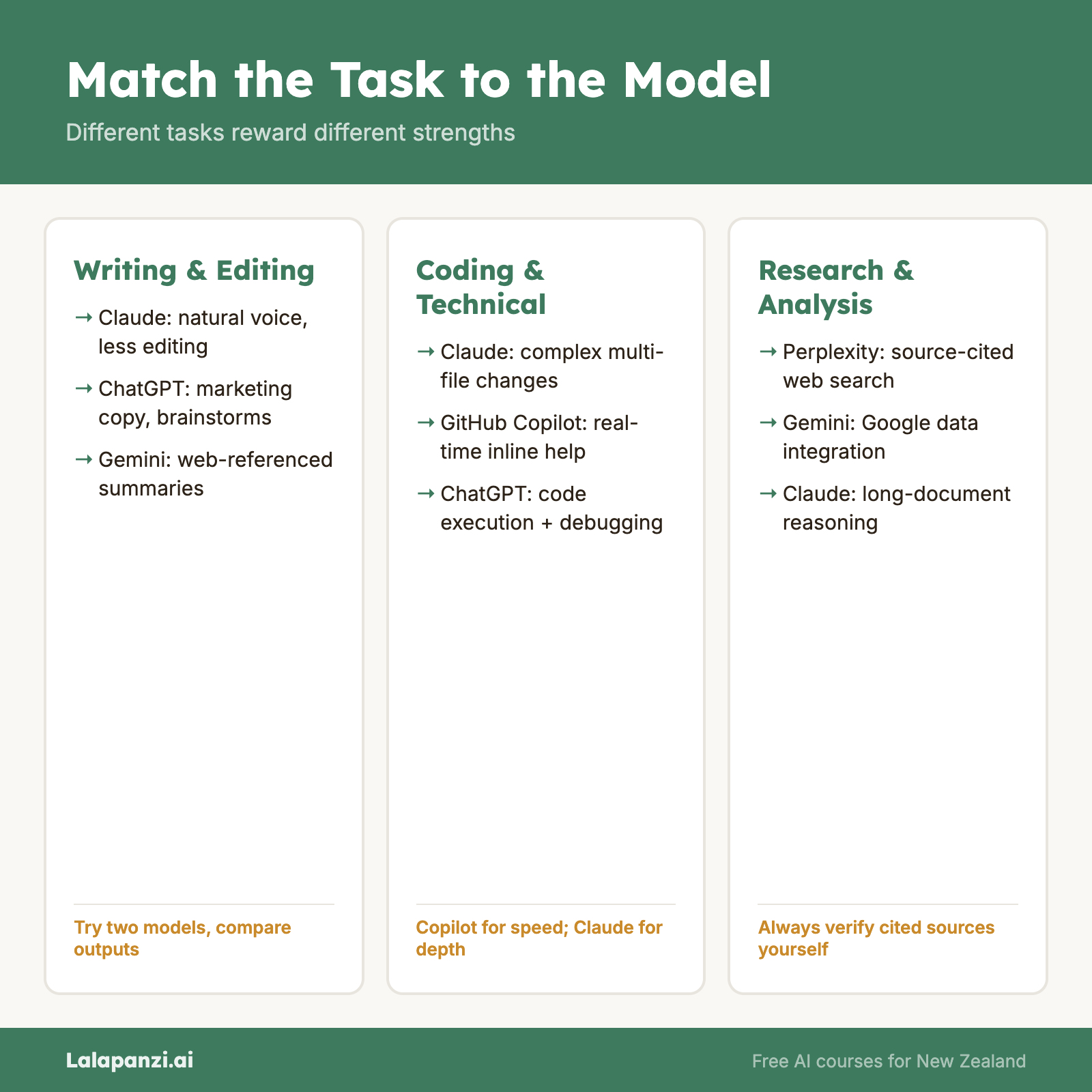
- Claude tends to produce natural, well-structured writing that needs less editing. It's particularly good at matching a requested tone and maintaining consistency across longer documents.
- ChatGPT is solid for conversational writing and brainstorming. It's widely used for marketing copy and social media content.
- Gemini handles writing competently, especially when you need it to reference or summarise information from the web. Its new Flash-Lite and Live models provide near-instantaneous response times for short-form writing and real-time conversational drafting.
- Meta Muse Spark is emerging as a strong contender for high-fidelity creative writing and highly nuanced stylistic adaptations.
- GPT-5.5 has set a new benchmark for high-fidelity professional writing, offering unprecedented control over nuance and complex stylistic requirements.
Practical tip: For important writing tasks, try the same prompt in two models and compare. You'll quickly develop a feel for which voice suits your needs.
2. Coding and Technical Work
Writing code, debugging, explaining technical concepts, working with data formats like JSON or CSV, writing formulas.
What matters here: Accuracy, understanding of programming languages, ability to debug, clear explanations of what the code does.
Strong options:
- Claude is well-regarded for code generation and explanation, particularly for longer, more complex pieces of code. It tends to write clean, well-commented code.
- ChatGPT has a strong coding reputation and benefits from its Code Interpreter feature, which can actually run code and show you results.
- Gemini is capable with code, and its integration with Google's ecosystem can be handy for certain workflows.
- Agentic Tool-Switchers: The latest generation of models now features native agentic tool-switching, allowing them to automatically pivot between different internal tools or external APIs based on the technical requirement of the sub-task, significantly reducing manual prompt engineering for complex workflows.
Practical tip: If you need code run and tested, ChatGPT's Code Interpreter is genuinely useful. If you need code written and explained, try Claude or ChatGPT and compare.
3. Analysis and Reasoning
Reviewing documents, comparing options, working through logical problems, summarising research, making sense of data.
What matters here: Accuracy, logical reasoning, ability to handle nuance, willingness to flag uncertainty rather than guess.
Strong options:
- Claude tends to be more cautious and thorough in analysis. It's more likely to flag when something is uncertain or when a question has multiple valid interpretations.
- ChatGPT's o-series models (like o1 and o3) are specifically designed for deeper reasoning tasks. If you have access, these are strong for complex analysis.
- Gemini can analyse documents and data effectively, especially when combined with Google Workspace integration.
Practical tip: For high-stakes analysis (business decisions, legal review, financial assessment), always cross-check the output. Use the AI as a starting point, not the final word.
4. Creative and Brainstorming
Generating ideas, exploring possibilities, creative writing, coming up with names, thinking through scenarios, roleplaying different perspectives.
What matters here: Creativity, willingness to explore unusual ideas, variety of suggestions, ability to build on your input.
Strong options:
- ChatGPT is often praised for brainstorming. It tends to generate a wide range of ideas quickly and can be pushed to get more creative.
- Claude can be excellent for creative work, especially when you want more thoughtful or nuanced output. It handles complex creative briefs well.
- Gemini is solid for brainstorming, particularly when you want ideas grounded in real-world examples it can pull from the web.
Practical tip: For brainstorming, quantity matters early on. Ask for 20 ideas, not 5. You can always narrow down later.
5. Research and Information
Finding information, explaining topics, summarising current events, answering factual questions.
What matters here: Accuracy, recency of information, ability to cite sources, honesty about limitations.
Strong options:
- Gemini has a natural advantage here because of its integration with Google Search. It can pull in current information and often provides links.
- ChatGPT with browsing enabled can search the web, though results vary in quality.
- Perplexity AI (a free tool worth knowing about) is specifically designed for research. It searches the web and provides cited answers. It's not a general-purpose AI but excellent for research specifically.
Practical tip: For anything factual, always verify. AI models can present incorrect information with complete confidence. The more specific your question, the more likely you'll get an accurate answer.
Your Decision Framework
Here's a simple process you can follow every time:
Step 1: What type of task is this? Identify which of the five categories your task falls into. Some tasks span multiple categories — a report might involve research and writing, for example.
Step 2: What matters most? For this specific task, what's your priority? Speed? Accuracy? Creativity? Tone? This helps you choose between options.
Step 3: Start with your default, switch if needed. Pick one model as your everyday default (whichever you find most comfortable) and use it for most things. Switch to a specialist when the task demands it.
Step 4: Compare when it matters. For important tasks, spend two minutes running the same prompt through a second model. The comparison is often more valuable than either individual response.
Step 5: Build your own experience. Over time, you'll develop intuitions about which model works best for your specific needs. Trust that experience — it's more valuable than any generic recommendation.
A Note on "Best"
Model capabilities change frequently. A model that's weaker at coding today might release an update next month that makes it the strongest option. The framework above — categorise the task, know what matters, compare when it counts — stays useful regardless of which model is currently ahead.
The goal isn't to memorise which model is "best" at what. The goal is to develop the habit of thinking about what you need before you start typing.
Key Takeaways
- No single model wins at everything. Each has strengths across writing, coding, analysis, creative work, and research.
- Match the model to the task type. A model that's brilliant for brainstorming might not be your best choice for careful analysis.
- Build a simple decision habit: identify the task type, know your priority, start with your default, and compare when it matters.
- For research and factual questions, always verify. AI confidence doesn't equal accuracy.
- Your own experience is the best guide. Generic recommendations are starting points — your specific needs will shape your preferences over time.
Exercise: Build Your Personal Model Map
Take five tasks you've done (or want to do) in the past week. For each one:
- Categorise it (writing, coding, analysis, creative, research).
- Identify what matters most for that task.
- Choose which model you'd try first.
- If you have access to multiple models, run the same prompt through two of them and note which output you preferred — and why.
Write down your observations. This is the beginning of your personal model map.
Quiz
1. You need to brainstorm 20 potential names for a new product. Which approach is most effective?
a) Use whichever model is rated highest on benchmarks
b) Ask one model for 20 ideas, then try a second model for comparison
c) Search Google instead — AI isn't good at creative tasks
d) Ask for 3 ideas at a time across multiple conversations
Answer: b) For brainstorming, generating lots of options matters. Running the same prompt through two models gives you wider variety and helps you learn which model suits your creative style.
2. You're analysing a complex business proposal and need to identify potential risks. What matters most when choosing a model?
a) Speed of response
b) Creative flair in the output
c) Accuracy, logical reasoning, and willingness to flag uncertainty
d) The model's ability to search the web
Answer: c) For analysis tasks, you want a model that reasons carefully and is honest about what it's unsure of. Speed and creativity are secondary to getting the analysis right.
3. What's the most reliable long-term approach to choosing AI models?
a) Memorise which model is best at each task and stick with that
b) Always use the newest model available
c) Develop a framework for matching tasks to models, and build experience through comparison
d) Pick one model and use it for everything to avoid confusion
Answer: c) Model capabilities change frequently, so memorising rankings becomes outdated quickly. A framework-based approach — combined with your own experience — stays useful regardless of which model is currently ahead.
Visual overview