Lesson 2: The Major Platforms — ChatGPT, Claude, Gemini, Copilot, Grok, Perplexity
Listen to this lesson
Lesson 2: The Major Platforms — ChatGPT, Claude, Gemini, Copilot, Grok, Perplexity, Meta AI
Course: Choosing the Right AI Model (Personal Pathway, Free) Estimated reading time: 10 minutes **Last updated: 2026-07-14
The Big Seven (and Who's Behind Them)
In Lesson 1, we established that platforms and models are different things. Now let's meet the major platforms you're likely to encounter, who built them, and what makes each one worth knowing about.
Think of this as a field guide. You don't need to use all of these — most people settle on one or two favourites. But knowing what's out there means you can make an informed choice rather than just using whatever you heard about first.
1. ChatGPT — The One Everyone Knows
Company: OpenAI (San Francisco, USA) Website: chat.openai.com Models: GPT-5.6, GPT-5.5, reasoning models (o-series), GPT-5.6 Sol
ChatGPT is the platform that brought AI into the mainstream in late 2022. It's the most widely used AI chatbot in the world, and for good reason — it's polished, versatile, and constantly improving.
What it does well:
- General-purpose conversation and writing
- Image generation (via DALL-E integration)
- Image and document analysis (upload a photo, ask questions about it)
- Code writing and debugging
- Voice conversation mode
- Custom GPTs — tailored versions for specific tasks
- Integrating high-performance open-weights models like DeepSeek V4 for specialised coding and reasoning tasks
What to know:
- Free tier now defaults to GPT-5.6 — a significant upgrade from earlier free models (limited to roughly 10 messages per 5 hours)
- ChatGPT Go (US$8/month) is a new lighter paid tier for users who need more than free but don't want full Plus
- Plus subscription (US$20/month) gives access to higher-capability reasoning models and features
- OpenAI has faced controversy around safety practices and leadership changes, but the product remains strong
- The company started as a non-profit research lab and has shifted toward a commercial model
- Model updates (July 2026): GPT-5.6 is now the default, with GPT-5.6 Sol available for the hardest reasoning tasks on paid tiers. The free tier now includes a model that would have been flagship-level a year ago.
Best for: People who want one tool that does a bit of everything, and who value a large ecosystem of plugins and custom GPTs.
2. Claude — The Thoughtful Writer
Company: Anthropic (San Francisco, USA) Website: claude.ai Models: Claude Haiku 4.5, Claude Sonnet 5, Claude Opus 4.8
Anthropic was founded by former OpenAI researchers who wanted to build AI with a stronger focus on safety. Claude has earned a reputation for being particularly good at nuanced writing, careful reasoning, and following complex instructions.
What it does well:
- Long, detailed writing (articles, reports, creative fiction)
- Analysing large documents — Claude has one of the largest context windows available, meaning it can read and work with very long texts at once
- Following nuanced instructions faithfully
- Coding, particularly with careful explanations
- Being honest about uncertainty — Claude is more likely to say "I'm not sure" than make something up
What to know:
- Free tier now defaults to Claude Sonnet 5 — a significant step up from previous free offerings, with usage limits
- Pro subscription (US$20/month) gives higher limits and access to Claude Opus 4.8
- Anthropic is backed by Google and various investors
- Claude's "character" tends to be more measured and considered than some competitors
- Model updates (July 2026): Claude Sonnet 5 is now the free-tier default, and Opus 4.8 is the latest flagship model available to Pro subscribers. The gap between free and paid tiers has narrowed considerably.
Best for: Writers, researchers, and anyone who values careful, detailed responses. Excellent for working with long documents.
3. Gemini — Google's Contender
Company: Google DeepMind (London/Mountain View) Website: gemini.google.com Models: Gemini 3.5 Flash, Gemini 3.1 Flash-Lite, Gemini 3.1 Flash Live, Gemini 2.5 Pro
Google has been doing AI research longer than almost anyone, and Gemini is their flagship consumer product. Its biggest advantage? Deep integration with Google's ecosystem — Search, Gmail, Docs, Drive, YouTube, Maps.
What it does well:
- Anything involving Google services (summarising emails, drafting in Docs, analysing spreadsheets)
- Multimodal tasks — understanding images, video, and audio natively
- Access to current information through Google Search integration
- Long context windows (Gemini models can process very large amounts of text)
What to know:
- Free tier now includes Gemini 3.5 Flash — a fast, capable model
- Google One AI Premium (part of Google One subscription) unlocks advanced features
- Available within Google Workspace apps, making it handy for work tasks
- Google has rebranded their AI products several times (Bard to Gemini), which can be confusing
- Model updates (July 2026): Gemini 3.5 Flash is now available in the free Gemini app and AI Studio. The 3.1 Flash-Lite model is designed for extreme speed and low cost, making it a top choice for developers scaling AI features. Flash Live enables near-instantaneous multimodal interaction, reducing the friction between human intent and AI response.
Best for: People already in the Google ecosystem who want AI woven into their existing workflow. Strong for research tasks thanks to Search integration.
4. Copilot — Microsoft's AI Layer
Company: Microsoft (Redmond, USA) — using OpenAI models Website: copilot.microsoft.com Models: Primarily GPT-4o and other OpenAI models
Microsoft invested heavily in OpenAI and built Copilot as the way to bring AI into Windows, Office, Edge, and Bing. If your life runs on Microsoft products, Copilot is designed to meet you where you already are.
What it does well:
- Integration with Microsoft 365 — Word, Excel, PowerPoint, Outlook, Teams
- Web search with AI-generated summaries (via Bing)
- Image generation (via DALL-E)
- Enterprise features for organisations already on Microsoft
What to know:
- Basic Copilot is free in Windows and Edge
- Copilot Pro (US$20/month) adds AI features in Office apps
- Microsoft 365 Copilot for businesses is significantly more expensive (US$30/user/month)
- Under the hood, it's largely running OpenAI's models — so the raw capability is similar to ChatGPT
- The experience varies depending on where you access it (Bing, Windows, Office)
Best for: People and businesses embedded in the Microsoft ecosystem. Particularly strong if you need AI in Excel, Word, and PowerPoint.
-
Meta AI — The Open Challenger Company: Meta (Menlo Park, USA) Website: meta.ai / Integrated into WhatsApp, Instagram, Messenger Models: Llama series (latest updates including 2026 releases) and Muse Spark
Meta has taken a different path by leaning into the "open" nature of its Llama models, which allows developers worldwide to build on top of them. Their consumer platform, Meta AI, is designed to be where you already spend your time—inside your social apps.
What it does well:
- Accessibility — integrated directly into WhatsApp, Instagram, and Messenger
- Fast, efficient responses for quick queries
- Strong performance in a wide variety of general tasks
- Integration with Meta's social graph for some features
What to know:
- Meta continues to iterate rapidly on the Llama ecosystem to close the gap with Google and OpenAI.
- New for 2026: The introduction of Meta Muse Spark, a high-performance model designed for extreme speed and efficiency, now available via API for third-party developers.
- Because it's integrated into social apps, it's often the easiest AI for non-technical users to start with.
Best for: Users who want AI integrated into their messaging apps and developers who prefer the flexibility of an open-weights model ecosystem.
5. Grok — The Unfiltered Alternative
Company: xAI (founded by Elon Musk) Website: Available through X (formerly Twitter) Models: Grok-3, Grok-4.3
Grok takes a different approach. Built by Elon Musk's xAI, it positions itself as less restricted in what it will discuss and has real-time access to posts on X (Twitter). It tends to have a more informal, sometimes edgy personality.
What it does well:
- Real-time information from X/Twitter
- Willing to engage with topics other platforms might decline
- Image generation and analysis
- A more casual, direct conversational style
What to know:
- Primarily available through X Premium subscriptions
- The "less restricted" approach is a feature for some and a concern for others
- Grok 4.3 is the latest release, continuing rapid iteration
- Closely tied to the X platform, which may or may not suit you
Best for: People who want real-time social media context, or who find other platforms too cautious in what they'll discuss. Popular with X/Twitter power users.
6. Perplexity — The Research Engine
Company: Perplexity AI (San Francisco, USA) Website: perplexity.ai Models: Uses multiple models including their own, plus Claude and GPT models
Perplexity is different from the others. Rather than being a general-purpose chatbot, it's built specifically for research. Every answer comes with citations — links to the sources it used. Think of it as what Google Search could be if it actually answered your questions directly.
What it does well:
- Research with cited sources — every claim is linked to where it came from
- Current information (searches the web in real time)
- Academic and professional research
- Quick factual answers you can verify
- Focus mode for different types of search (academic papers, Reddit discussions, YouTube, etc.)
What to know:
- Free tier is genuinely useful
- Pro subscription (US$20/month) gives more searches and access to more powerful models
- Less suited for creative writing or open-ended conversation
- Can sometimes hallucinate despite the citations — always check the sources
- Uses a mix of its own and third-party models
Best for: Anyone who needs factual, sourced information. Excellent for research, journalism, academic work, and anyone who wants to verify what AI tells them.
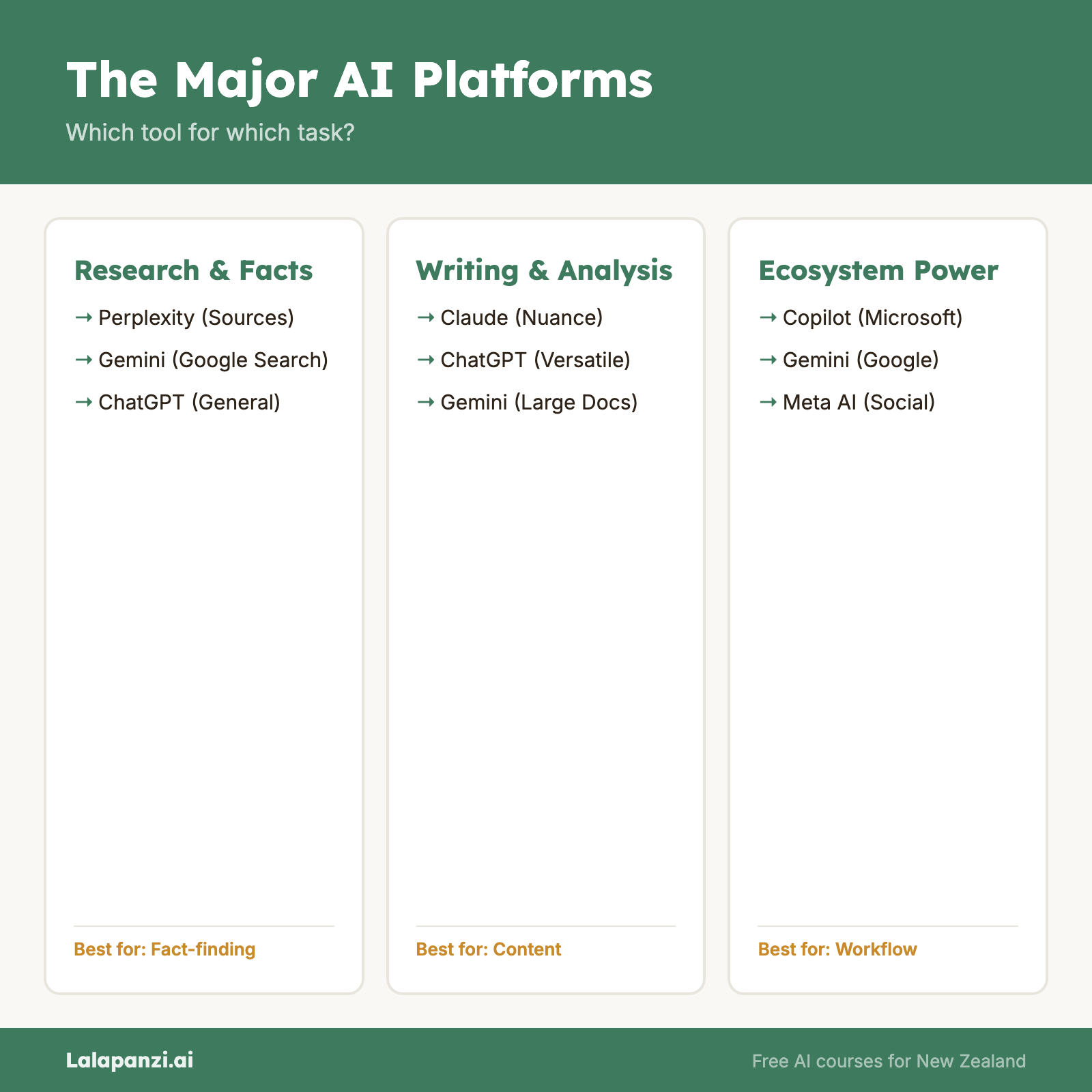
So Which One Should You Use?
There's no single right answer — it depends on what you do most often. Here's a rough guide:
- Writing and analysis: Claude or ChatGPT
- Research with sources: Perplexity
- Google ecosystem: Gemini
- Microsoft ecosystem: Copilot
- General all-rounder: ChatGPT
- Social media context: Grok
- Open ecosystem & developers: Meta AI
Most people end up using two or three for different tasks. That's perfectly normal and often the smartest approach.
The good news? Almost all of these have free tiers. You can try each one without spending a cent and see which fits you best.
Key Takeaways
- Seven major platforms dominate the consumer AI space, each backed by different companies with different philosophies.
- ChatGPT is the most popular but not necessarily the best for every task. Competition has produced genuine alternatives.
- Your existing ecosystem matters. If you live in Google or Microsoft's world, their AI tools integrate seamlessly.
- Perplexity is uniquely useful for research because it cites its sources — something most chatbots don't do.
- Most platforms have free tiers. Try before you commit to any paid subscription.
Practical Exercise
Time needed: 20-30 minutes
- Pick a question you genuinely want answered. Something you'd normally Google — maybe "What's the best way to insulate a villa in New Zealand?" or "How do I start a side business while employed?"
- Ask the same question to at least three different platforms. Use the free tiers — no payment needed.
- Try: ChatGPT (chat.openai.com), Claude (claude.ai), and Perplexity (perplexity.ai)
- Compare the responses:
- Which answer was most helpful?
- Which was most detailed?
- Which provided sources or evidence?
- Which had the best tone for you personally?
- Write down your initial impressions. There's no wrong answer — this is about finding what works for you.
Knowledge Check
1. What makes Perplexity different from most other AI platforms?
- a) It's the only one that's free
- b) It provides citations and sources for its answers ✅
- c) It's the only one that can generate images
- d) It was the first AI chatbot available to the public
2. What AI models does Microsoft Copilot primarily use?
- a) Google's Gemini models
- b) Anthropic's Claude models
- c) OpenAI's GPT models ✅
- d) Its own proprietary models unrelated to any other company
3. If you work heavily in Google Docs, Sheets, and Gmail, which platform would integrate most naturally?
- a) ChatGPT
- b) Claude
- c) Gemini ✅
- d) Grok
Visual overview