Module 5, Lesson 3: Techniques — Role-Setting, Few-Shot Examples, and Chain-of-Thought
Listen to this lesson
Module 5, Lesson 3: Techniques — Role-Setting, Few-Shot Examples, and Chain-of-Thought
Estimated reading time: 9 minutes
Introduction
You've got the four-part framework — context, task, format, constraints. That alone puts you ahead of most people using AI tools. But there are a few specific techniques that can push your results even further.
These aren't tricks or hacks. They're proven ways to communicate more effectively with AI models. Think of them as power tools: you don't need them for every job, but when you do, they make a huge difference.
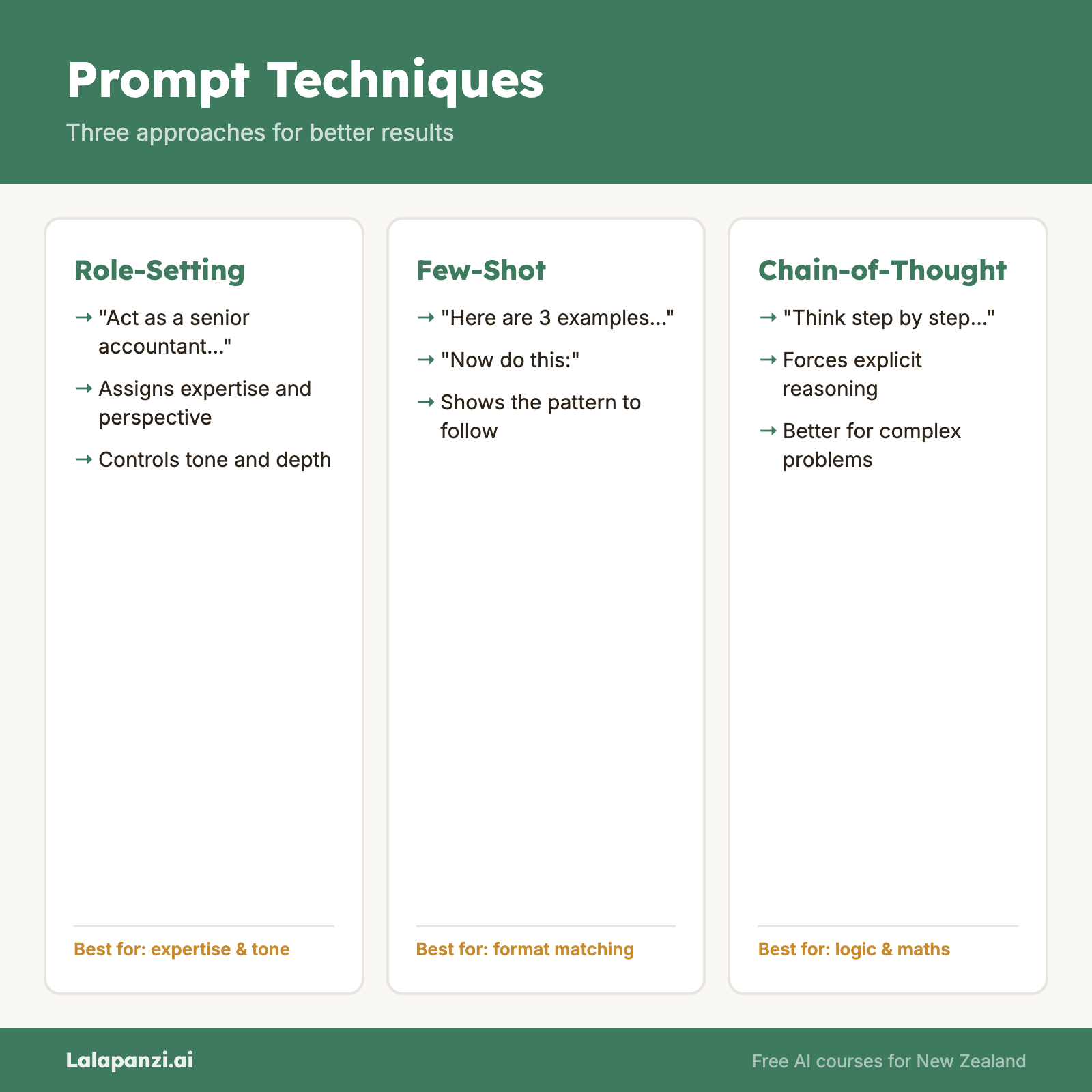
We'll cover three:
- Role-setting — giving the AI a persona or expertise to work from
- Few-shot examples — showing the AI what you want by giving it samples
- Chain-of-thought — asking the AI to think step by step
Technique 1: Role-Setting
When you give an AI a role, you're anchoring its responses to a specific perspective and level of expertise. It changes the vocabulary, depth, and focus of the output.
❌ Without a Role
How should I price my consulting services?
You'll get a generic overview of pricing strategies. Accurate, but shallow. It reads like a business textbook.
✅ With a Role
You are an experienced business consultant who specialises in helping small service-based businesses in New Zealand set their pricing. I'm a freelance graphic designer starting out and I don't know how to price my work. Walk me through how to figure out the right pricing for my services.
Now the AI responds as someone with specific expertise, talking directly to your situation. The advice becomes more practical, more nuanced, and more relevant.
When to Use Role-Setting
- When you need specialist knowledge (legal, medical, financial, technical)
- When you want a specific perspective (e.g., "as a sceptical customer" or "as a hiring manager")
- When tone matters (e.g., "as a patient, encouraging teacher")
- When you want the AI to challenge your ideas (e.g., "as a devil's advocate")
Some Useful Roles
- "You are an experienced NZ employment lawyer..."
- "You are a high school science teacher explaining this to a 15-year-old..."
- "You are a senior data analyst reviewing this spreadsheet..."
- "You are a direct, no-nonsense business mentor..."
- "You are a professional copywriter who specialises in email marketing..."
A word of caution: Role-setting changes how the AI frames its responses, but it doesn't give the AI actual qualifications. An AI "acting as a lawyer" can give you useful general guidance, but it's not legal advice. Always verify anything high-stakes with a real professional.
Technique 2: Few-Shot Examples
"Few-shot" means giving the AI a few examples of what you want before asking it to produce something. It's incredibly effective because the AI can match the pattern, style, and structure of your examples.
This is particularly useful when you need a specific format, tone, or style that's hard to describe in words.
❌ Without Examples
Write product descriptions for my online store.
The AI will guess at length, tone, and structure. You'll probably need to rewrite everything.
✅ With Examples (Few-Shot)
I need product descriptions for my online store. Here are two examples of the style I want:
Example 1: Merino Wool Beanie — $45 Knitted from 100% NZ merino wool. Soft, warm, and built to last. One size fits most. Available in charcoal, navy, and cream.
Example 2: Canvas Tote Bag — $38 Heavy-duty cotton canvas with reinforced handles. Fits a laptop, a lunch, and whatever else the day throws at you. Natural colour with screen-printed logo.
Now write descriptions in the same style for these products:
- Ceramic coffee mug, $28, handmade, 350ml, dishwasher safe, comes in 4 colours
- Linen tea towel, $22, NZ flax design, 100% linen, made in Christchurch
The AI will match your tone (casual, confident), your structure (name, price, short description, key details), and your length. Much faster than trying to describe all of that in instructions.
When to Use Few-Shot Examples
- Matching a specific writing style or brand voice
- Producing formatted data (like consistent product listings, social posts, or database entries)
- When "I'll know it when I see it" is easier than describing it
- Training the AI on your preferred output structure
How Many Examples?
Two to three examples usually does it. One example works for simple patterns. More than five is rarely needed — at that point, you're better off describing the pattern directly.
Technique 3: Chain-of-Thought
This is the most powerful technique for complex reasoning tasks. Instead of asking the AI for a final answer, you ask it to think through the problem step by step.
Why does this work? AI models produce better answers when they work through their reasoning rather than jumping to conclusions — much like humans do.
July 2026 Update: Self-Correction and Adaptive Reasoning
Recent research confirms that adding explicit self-correction prompts improves accuracy by around 20–25% on complex reasoning tasks. After the chain-of-thought reasoning, add: "Now review your reasoning above. Identify any potential mistakes or assumptions and revise your answer if needed." This technique works particularly well for mathematical problems and logical deductions.
Additionally, many 2026 frontier models (such as GPT-5.6 and Claude Sonnet 5) now support adaptive reasoning — they automatically decide how long to "think" based on task difficulty. You can often control this with an effort or thinking-budget parameter if you need deeper reasoning for a hard problem, or faster responses for a simple one. Chain-of-thought prompting remains valuable even with these built-in capabilities, as it directs what the model thinks about, not just how long.
❌ Without Chain-of-Thought
Should I lease or buy a vehicle for my business?
The AI might give you a one-sided answer or a vague "it depends." Not particularly useful.
✅ With Chain-of-Thought
I run a small plumbing business in Tauranga. I need a ute for work — it'll do about 30,000 km per year and I need it for at least 4 years. My annual revenue is around $180,000.
Think through this step by step: should I lease or buy the vehicle? Consider the financial implications, tax treatment in NZ, cash flow impact, and any other factors a small business owner should weigh up. Show your reasoning before giving a recommendation.
Now the AI walks through the logic: depreciation, GST implications, cash flow, interest costs, flexibility. You can follow the reasoning, check it makes sense, and make an informed decision.
The Key Phrases
You can trigger chain-of-thought reasoning with phrases like:
- "Think through this step by step"
- "Walk me through your reasoning"
- "Before giving your answer, consider each factor"
- "Show your working"
- "Break this down step by step"
When to Use Chain-of-Thought
- Complex decisions with multiple factors
- Maths or logic problems
- Comparing options (tools, strategies, approaches)
- Debugging something — "work through what might be going wrong"
- Any time you need to verify the AI's reasoning, not just trust its conclusion
Combining Techniques
These techniques work beautifully together. Here's an example that uses all three:
[Role] You are a senior marketing strategist who has worked with small NZ businesses for 15 years.
[Few-shot example] Here's the kind of marketing plan summary I'm after:
Quarter 1 Focus: Local SEO Why: 73% of our customers find us via Google search. Improving our local listing and getting reviews will have the highest ROI. Actions: Claim Google Business Profile, email 20 recent customers for reviews, update website with location pages. Budget: $500 (website updates) + staff time
[Chain-of-thought + Task] Now, think through what the priorities should be for a new café opening in central Christchurch. Consider the first 6 months. Walk through your reasoning for each quarter's focus, then present the plan in the same format as my example above.
This prompt will produce a structured, well-reasoned marketing plan that matches your preferred format. That's three techniques working together in one prompt.
A Note on When NOT to Use These
Not every prompt needs advanced techniques. If you're asking "What year was the Treaty of Waitangi signed?" — just ask. Role-setting and chain-of-thought would be overkill.
Use these techniques when:
- The basic four-part framework isn't getting you good enough results
- The task is complex or requires nuanced thinking
- You need a very specific style or format
- You want to understand the AI's reasoning, not just its conclusion
Key Takeaways
- Role-setting gives the AI a persona and expertise level, producing more relevant and nuanced responses.
- Few-shot examples show the AI exactly what you want — often more effective than describing it.
- Chain-of-thought asks the AI to reason step by step, dramatically improving results for complex tasks.
- These techniques combine well — use role + examples + chain-of-thought together for the best results on important tasks.
- Match the technique to the task — simple questions don't need advanced techniques.
Practical Exercise
Task: Try each technique on a real task.
-
Role-setting: Pick a topic you'd like advice on. Write the prompt twice — once without a role, once with a specific role assigned. Compare the depth and relevance of the responses.
-
Few-shot examples: Find something you've written before that you like (an email, a social post, a product description). Paste 2-3 examples into a prompt and ask the AI to write a new one in the same style. How close does it get?
-
Chain-of-thought: Think of a decision you're currently weighing up — personal or professional. Ask the AI to think through it step by step, providing relevant context. Did the step-by-step reasoning surface anything you hadn't considered?
-
Combined: Write one prompt that uses at least two of the three techniques together. Notice how the quality improves when techniques are layered.
Knowledge Check
1. What does "few-shot" mean in prompt engineering?
a) Giving the AI a very short prompt b) Providing a few examples of the desired output before asking for the task c) Asking the AI to try multiple times d) Limiting the AI's response to a few sentences
Answer: b) Few-shot means giving the AI a small number of examples so it can match the pattern, style, or structure in its response.
2. When is chain-of-thought prompting most useful?
a) When you need a one-word answer b) When the task involves complex reasoning or multiple factors c) When you want the AI to be creative d) When you're writing a social media post
Answer: b) Chain-of-thought is most valuable for complex decisions, multi-step problems, and tasks where you want to follow (and verify) the AI's reasoning.
3. You want the AI to write blog posts that match your brand's specific writing style. Which technique would be most effective?
a) Role-setting b) Few-shot examples c) Chain-of-thought d) Adding more constraints
Answer: b) Few-shot examples are the most effective way to match a specific writing style — show the AI what your style looks like, and it will replicate it.
Visual overview