Module 5, Lesson 4: Iterating — How to Refine When the First Result Isn't Right
Listen to this lesson
Module 5, Lesson 4: Iterating — How to Refine When the First Result Isn't Right
Estimated reading time: 8 minutes
Introduction
Here's something most people get wrong about AI: they treat every prompt like a one-shot deal. Type something in, get a response, accept it or give up.
That's not how good AI use works.
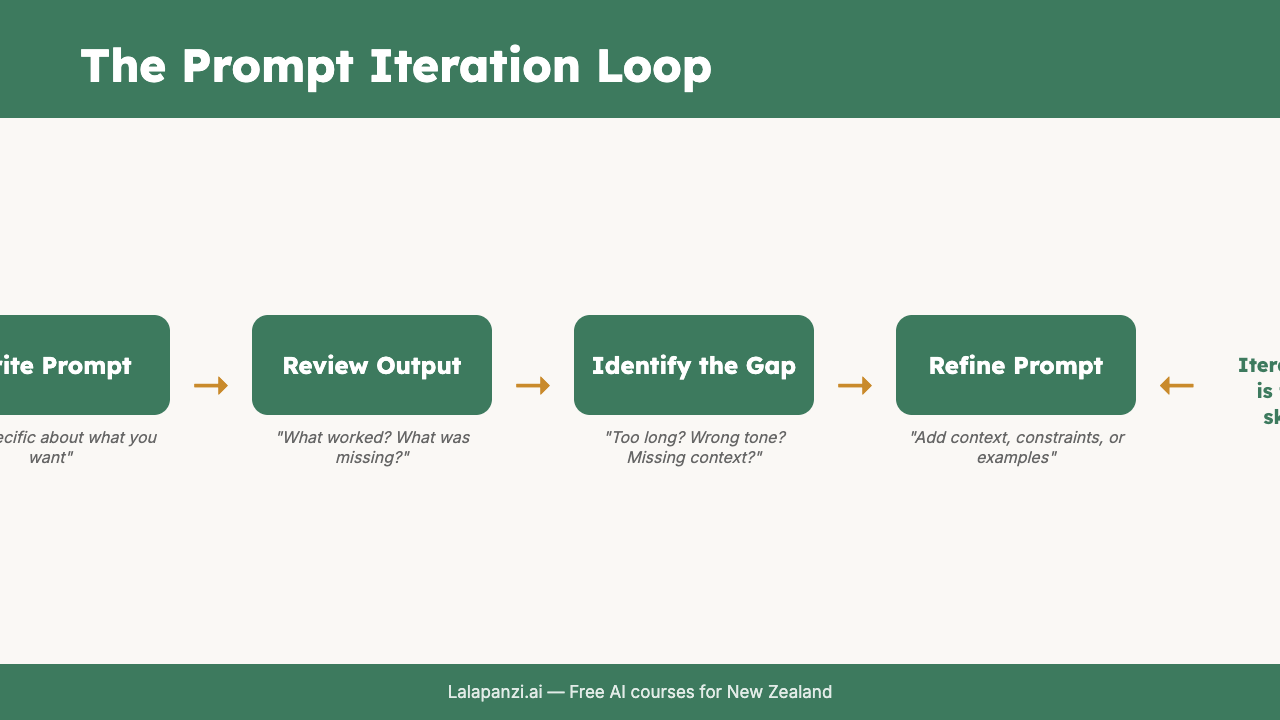
The best results almost always come from iteration — sending a prompt, reviewing the output, and then refining. It's a conversation, not a vending machine. You put in your request, see what comes back, and then steer.
This is a lesson that changes how you use AI forever, because once you start iterating, you stop being disappointed by first drafts and start seeing them as starting points.
Why the First Response Is Rarely the Final Answer
Even with a well-crafted prompt, the first response might not be exactly what you need. That's normal. It's not a failure — it's part of the process.
The first response might be:
- Too long or too short
- Right content, wrong tone
- Mostly good but missing something important
- Structured in a way that doesn't work for you
- Technically accurate but not practical enough
All of these are fixable — without starting from scratch.
The Iteration Mindset
Think of it like working with a colleague. You wouldn't hand someone a brief and expect perfection on the first draft. You'd review it, give feedback, and ask for adjustments. AI works exactly the same way.
The key insight: you don't need to rewrite your entire prompt each time. You can simply tell the AI what to change.
Iteration in Practice
Let's walk through a real example from start to finish.
First Prompt
Write a one-page overview of our new employee wellness programme for all staff. We're a mid-size accounting firm in Christchurch, 45 staff. The programme includes flexible hours, mental health support through EAP, a $500 annual wellness budget per person, and monthly team activities. Professional but warm tone.
First Response (summarised)
The AI produces a solid overview but it's quite formal, runs a bit long, and the wellness budget details are buried in a paragraph.
Iteration 1: Adjust the Tone
That's good, but the tone is too corporate. Make it warmer and more conversational — like a message from a manager who genuinely cares, not an HR policy document.
The AI rewrites with a friendlier tone while keeping the same content.
Iteration 2: Fix the Structure
Better. Now pull the $500 wellness budget into its own section with a short heading — that's the thing people will be most excited about and I don't want them to miss it.
The AI restructures to highlight the budget.
Iteration 3: Tighten the Length
Nearly there. Cut it down to fit on one page — roughly 350 words. Keep all the key details but tighten the language.
The AI condenses while preserving the important information.
Total time for three iterations: about 3 minutes. And the final result is dramatically better than the first draft.
Useful Iteration Phrases
You don't need to overthink your follow-up prompts. Here are some phrases that work well:
For tone adjustments:
- "Make it more casual / formal / direct / empathetic"
- "This reads too much like a textbook — make it sound like a person talking"
- "Tone it down — it's too enthusiastic"
For content changes:
- "Add a section about [topic]"
- "Remove the part about [topic] — it's not relevant"
- "Expand on point 3 — give me more detail there"
- "The second paragraph isn't accurate — here's what it should say: [correction]"
For structure:
- "Reorganise this with the most important point first"
- "Break this into bullet points instead of paragraphs"
- "Add headings so it's easier to scan"
- "Put this in a table format"
For length:
- "Cut this in half"
- "This needs to be under 200 words"
- "Expand this — it's too brief"
- "Keep points 1, 3, and 5. Cut the rest."
For quality:
- "This is too generic — make it more specific to [my situation]"
- "Be more concrete — give me actual numbers or examples"
- "Simplify the language — my audience isn't technical"
- "This is good but feels like it could apply to any business. Make it specific to a NZ landscaping company."
When to Start Over vs. When to Iterate
Sometimes iteration isn't the right move. If the AI has gone completely off track — misunderstood the task entirely — it's faster to write a new prompt than to try to steer the current conversation back.
Iterate when:
- The response is in the right direction but needs adjustments
- Tone, length, or structure need tweaking
- Some parts are good and some need changing
- You want to add or remove specific content
Start fresh when:
- The AI misunderstood the task entirely
- The response is so far off that fixing it would take longer than starting over
- You've iterated 5+ times and it's still not right (your original prompt probably needs rethinking)
- You've gone down a rabbit hole and the conversation context is muddled
A Powerful Technique: Ask the AI to Critique Itself
One of the most underrated iteration moves is asking the AI to review its own output before you refine.
❌ Bad Prompt
Write a business proposal for expanding our café into catering.
(You get a result that seems okay but you're not sure what's missing.)
✅ Better Approach
After receiving the first draft:
Review what you just wrote. What's missing? What could be stronger? What would a potential investor want to see that isn't here?
The AI will often identify gaps you hadn't thought of — financial projections, competitor analysis, risk factors, staffing needs. Then you can say:
Good points. Now rewrite the proposal with those improvements included.
You've just used the AI as both the writer and the editor. Two perspectives for the price of one.
The Three-Pass Method
Here's a simple process that works well for important content:
- Pass 1: Get the content right. Focus your prompt on what you need. Don't worry about polish.
- Pass 2: Get the structure right. Ask the AI to reorganise, add headings, or change format.
- Pass 3: Get the tone right. Fine-tune the voice, formality, and feel.
Trying to get all three right in the first prompt is hard. Separating them into passes is easier and produces better results.
Real Iteration: Email Example
Let's see the three-pass method on a quick task.
Pass 1:
Write an email to my team announcing that we're moving offices next month. New office is in Ponsonby, Auckland. Bigger space, better kitchen, closer to public transport. Move date is 15 March.
Pass 2:
Good content. Restructure it: lead with the move date (people will want to know that first), then the new location, then the benefits. Add a line asking people to flag any concerns by end of this week.
Pass 3:
Make the tone a bit more upbeat — this is good news. And end with something about being excited for the fresh start. Keep it under 200 words.
Three quick passes, each one focused. Final result: a polished, ready-to-send email.
Key Takeaways
- Iteration is the norm, not the exception. The best AI results come from refining, not from one perfect prompt.
- You don't need to rewrite your prompt each time — just tell the AI what to change.
- The three-pass method works well: get the content right, then the structure, then the tone.
- Ask the AI to critique its own output — it's surprisingly good at spotting what's missing.
- Know when to start over — if you've gone too far off track, a fresh prompt is faster than more iterations.
Practical Exercise
Task: Practice the full iteration loop.
- Pick a piece of content you actually need — an email, a document, a social media post, a proposal.
- Write your best first prompt (using the framework from Lesson 2).
- Review the output. Don't accept it — find at least two things to improve.
- Iterate at least three times, giving specific feedback each time.
- Before your final iteration, ask the AI: "Review what you've written. What could be better?" Use its self-critique to guide one more refinement.
Reflect: Compare the first response to the final version. How much did iteration improve the result? Could you have gotten the final result with a single prompt?
Knowledge Check
1. What's the most effective way to iterate on an AI response?
a) Delete everything and start over b) Give specific feedback about what to change c) Write "try again" with no additional guidance d) Accept the first response and edit it yourself
Answer: b) Specific feedback — like adjusting tone, restructuring, or adding content — is the fastest way to improve AI output through iteration.
2. When should you start fresh with a new prompt rather than iterating?
a) When the tone isn't quite right b) When the response is too long c) When the AI has fundamentally misunderstood the task d) When you want a different format
Answer: c) Tone, length, and format issues are easily fixed through iteration. But if the AI has completely missed the point, starting fresh is more efficient.
3. What is the "three-pass method"?
a) Asking three different AI tools the same question b) Writing three separate prompts for three different tasks c) Refining in stages — content first, then structure, then tone d) Having three people review the AI's output
Answer: c) The three-pass method separates content, structure, and tone into distinct refinement stages, making each pass focused and effective.
Visual overview