What is Vibe Coding?
Listen to this lesson
What is Vibe Coding?
Course: Vibe Coding Fundamentals | Pathway: Builder | Tier: Free | Level: Beginner Estimated Reading Time: 7 minutes
Building Software by Describing What You Want in Plain Language
Here's something that would've sounded absurd five years ago: you can build working software without writing a single line of code. Not by dragging and dropping blocks in some limited website builder. By talking. By describing what you want in plain English, and having an AI write the code for you.
This is called vibe coding, and it's changing who gets to build things.
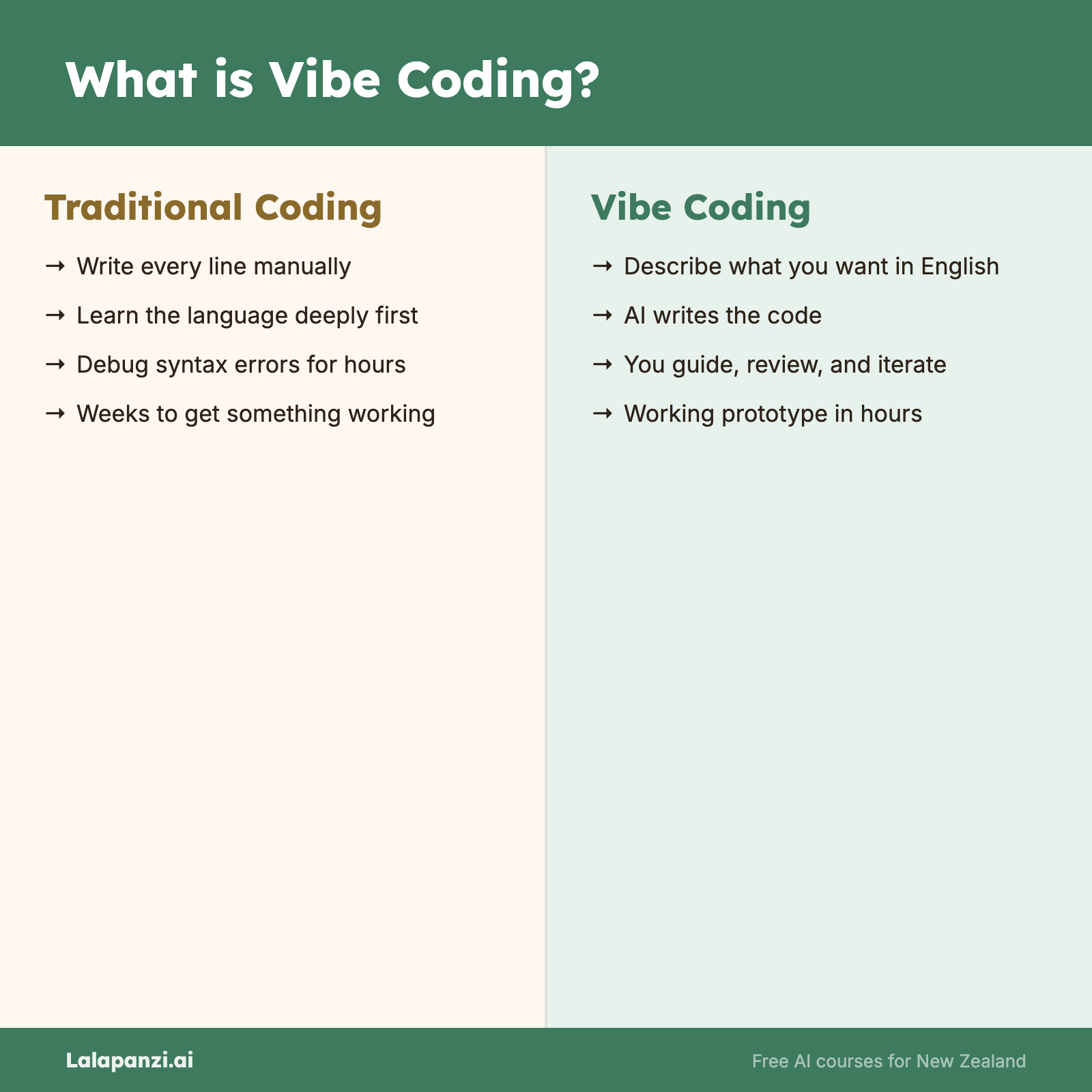
The Old Way vs. The New Way
Traditionally, if you wanted to build an app — even something simple like a to-do list — you'd need to:
- Learn a programming language (or several)
- Understand how files, folders, and frameworks fit together
- Spend months practising before you could build anything useful
- Debug cryptic error messages that made no sense
That barrier kept most people out. You had an idea? Great. Unless you could code or could afford a developer, that idea stayed in your head.
Vibe coding flips this entirely. Instead of learning how to write code, you learn how to describe what you want. The AI handles the rest.
What Does Vibe Coding Actually Look Like?
Imagine you want a simple website that shows your favourite recipes. Here's what a vibe coding conversation might look like:
You: "I want a simple recipe website. It should have a homepage that lists recipe names with photos, and when you click one, it shows the full recipe with ingredients and steps."
AI: Generates the complete HTML, CSS, and JavaScript for a working recipe website.
That's it. You described what you wanted. The AI built it. You can then look at it, try it out, and say things like:
- "Make the font bigger"
- "Add a search bar at the top"
- "Change the colour scheme to something warmer"
- "The ingredients list is too cramped — add more spacing"
Each time, the AI updates the code. You're directing the build, like an architect working with a builder. You don't need to know how to lay bricks to design a house.
Why "Vibe" Coding?
The term comes from Andrej Karpathy, one of the most respected AI researchers in the world. In early 2025, he described his approach: "I just see things, say things, run things, and copy-paste things, and it mostly works." He called it vibe coding — you go with the vibe, describe what feels right, and let the AI handle the technical details.
It's not a joke or a gimmick. It's a genuine shift in how software gets made.
What Can You Actually Build?
More than you'd expect. People are vibe coding:
- Personal websites and portfolios — professional-looking sites without touching code
- Simple web apps — calculators, trackers, organisers, quizzes
- Prototypes — turn a business idea into something you can show people
- Automations — scripts that rename files, sort data, send emails
- Browser extensions — little tools that customise how you use the web
- Data dashboards — pull information together and visualise it
There are limits, which we'll cover later in this course. But for a huge range of practical projects, vibe coding works remarkably well.
What Tools Do You Need?
The good news: you probably already have access to everything you need.
AI assistants that can write code:
- Claude (by Anthropic) — excellent at code generation, great at following complex instructions
- ChatGPT (by OpenAI) — widely used, solid code generation, good for beginners
- Google Gemini — another strong option with code capabilities
AI-native App Builders (Generative UI):
- v0.dev (by Vercel) — specializes in creating high-quality UI components and layouts from prompts
- bolt.new (by StackBlitz) — allows you to prompt a full-stack application into existence and deploy it instantly
- Lovable — focuses on rapid app creation with a high degree of polish and iteration speed
Where the code runs:
- For websites: your browser can preview HTML files directly
- For apps: tools like Replit let you run code instantly in your browser
- You don't need to install anything to get started
That's genuinely all you need. A browser and access to an AI assistant. No special software, no expensive tools, no computer science degree.
The 2026 Vibe Coding Landscape
By 2026, vibe coding has moved beyond simple code autocomplete to a new intuitive way of building. The mainstream approach now: "fully give in to the vibes, embrace exponentials, and forget that code even exists." Multiple tools now support this paradigm shift with distinct strengths:
The leading vibe coding tools (featuring multi-agent orchestration):
- Cursor — the most popular AI-native IDE, now featuring advanced multi-agent orchestration to handle complex architectural changes across entire projects, with deep understanding of your entire codebase and fast iteration cycles. Best for developers who want an editor that feels like it's reading your mind.
- Windsurf — a powerful proactive tool rival to Cursor, focusing on flow state and intelligent context awareness. It excels at complex projects where maintaining deep context across multiple files is critical for stability.
- GitHub Copilot Workspace — the enterprise choice that integrates seamlessly with GitHub repositories, ideal for teams already in the GitHub ecosystem.
- Claude Code — the conversational approach that excels at understanding complex, multi-step coding tasks through natural dialogue.
The ecosystem has matured significantly. Where once you might have struggled to describe what you wanted, today's tools understand context better, iterate faster, and can build working applications from plain-language descriptions with unprecedented reliability. The gap between "I want this" and "it exists" is narrower than ever.
The Skill That Actually Matters
Here's the thing most people don't realise: vibe coding isn't about the AI. It's about you. Specifically, it's about how clearly you can describe what you want.
This is called prompting — giving the AI clear, specific instructions. And it's a skill that improves with practice.
Compare these two prompts:
Vague: "Make me a website."
Clear: "Make me a single-page website for a dog-walking business called 'Happy Paws' in Wellington. It should have a hero section with a friendly headline, a section listing three services with prices, a section with customer testimonials, and a contact form at the bottom. Use a clean, modern design with green and white colours."
The second prompt will give you something dramatically better. Not because the AI is smarter — because you were clearer about what you wanted.
Throughout this course, you'll practise this skill. By the end, you'll be able to describe projects in a way that gets you excellent results on the first try.
Is This "Real" Coding?
Let's be honest about this. Vibe coding produces real, working code. The software functions. It runs. People can use it.
But you're not a software engineer after completing this course. And that's perfectly fine. A person who designs a house isn't a builder. A person who writes a brief isn't a copywriter. You're using AI as a tool to bring your ideas to life.
Some people start with vibe coding and later get curious about what's happening under the bonnet. We've got a course for that too (The Developer's Toolkit). But there's zero pressure. Plenty of people build genuinely useful things through vibe coding alone and never need to go deeper.
What's Next?
In the next lesson, you're going to build something real. Not hypothetical, not theoretical — an actual working project. You'll open an AI assistant, describe what you want, and walk away with something you made.
It's going to be easier than you think.
Key Takeaways
- Vibe coding means building software by describing what you want in plain language, with AI writing the code for you.
- No coding knowledge required — the skill that matters is being able to clearly describe what you want.
- You can build real things — websites, apps, tools, automations — using just a browser and an AI assistant.
- Prompting is the core skill — the clearer your description, the better the result.
- It's a legitimate approach — coined by a leading AI researcher, used by thousands of people building real projects.
Practical Exercise
Your first vibe coding conversation:
- Open Claude (claude.ai) or ChatGPT (chat.openai.com) — whichever you have access to.
- Type this prompt: "Create a simple HTML page that displays a personal greeting. It should say 'Welcome to [your name]'s page' in large text, with today's date below it, and a nice background colour."
- Replace
[your name]with your actual name. - Copy the code the AI gives you.
- Open a text editor (Notepad on Windows, TextEdit on Mac — set to plain text mode).
- Paste the code and save the file as
hello.html. - Double-click the file to open it in your browser.
Congratulations — you just vibe coded your first webpage.
Quiz
1. What is vibe coding?
a) A type of music-based programming language b) Building software by describing what you want in plain language, with AI writing the code c) A visual drag-and-drop website builder d) A shortcut for copying code from the internet
Answer: b) Vibe coding means describing what you want and letting AI write the working code for you.
2. What is the most important skill for vibe coding?
a) Knowing JavaScript b) Having an expensive computer c) Being able to clearly describe what you want d) Memorising programming syntax
Answer: c) Clear descriptions (prompts) are the core skill. The better you describe what you want, the better the result.
3. Which of the following can you build with vibe coding?
a) Personal websites b) Simple web apps and tools c) Automations and scripts d) All of the above
Answer: d) Vibe coding can be used to build websites, web apps, automations, browser extensions, and more.
Visual overview