Module 3, Lesson 1: Overview of Major AI Tools — ChatGPT, Claude, Gemini, Copilot
Listen to this lesson
Module 3, Lesson 1: Overview of Major AI Tools — ChatGPT, Claude, Gemini, Copilot
Estimated reading time: 8 minutes
The Big Four (and Why They Matter)
If you've heard of AI but haven't used it yet, the sheer number of tools out there can feel paralysing. Where do you even start?
The good news: in mid-2026, the AI tool landscape has settled into something more recognisable. There are four major general-purpose AI assistants that most people will encounter, and understanding what each one is will give you a solid foundation for everything else in this module.
Let's walk through them.
ChatGPT (by OpenAI)
ChatGPT is the tool that started the mainstream AI conversation. Launched in late 2022, it's still the most widely known AI assistant in the world.
What it is: A conversational AI tool that can answer questions, write text, analyse documents, generate images, browse the web, write code, and more. It's available as a website, a mobile app, and a desktop app.
The model behind it: ChatGPT runs on OpenAI's GPT model family. As of mid-2026, the latest flagship models are GPT-5.5 and GPT-5.5 Pro, with the lighter GPT-5.5 Instant available to free users. OpenAI now runs approximately 90-day model lifecycles — older models like GPT-4o have been retired, and reasoning models (the o-series) remain available for complex tasks. Free users get access to capable models with usage limits.
Who makes it: OpenAI, a US-based AI company. Originally founded as a non-profit, it has since shifted towards a commercial model — something that's generated a fair bit of controversy.
How you access it: chat.openai.com or the ChatGPT app. You can use it for free (with limits) or pay for ChatGPT Plus, Team, or Enterprise plans.
Claude (by Anthropic)
Claude is often described as ChatGPT's most direct competitor, but it has a noticeably different personality and set of strengths.
What it is: A conversational AI assistant, similar in concept to ChatGPT. It can write, analyse, code, summarise, and reason through problems. It's known for handling very long documents well and for giving thoughtful, nuanced responses.
The model behind it: Claude runs on Anthropic's Claude model family. As of mid-2026, the latest models are Claude Sonnet 5 (released June 2026, a capability upgrade at the same price as the previous generation) and Claude Opus 5 (released July 2026, the most powerful model for complex reasoning). Anthropic also offers lighter, faster models for less demanding tasks.
Who makes it: Anthropic, a US-based AI safety company founded by former OpenAI researchers. Their focus on safety research influences how Claude behaves — it tends to be more cautious and transparent about its limitations.
How you access it: claude.ai or the Claude app. Free tier available with usage limits; paid plans include Claude Pro and Team.
Gemini (by Google)
Gemini is Google's answer to ChatGPT, and it has one significant advantage: deep integration with Google's ecosystem.
What it is: Google's AI assistant, available as a standalone tool and increasingly woven into Google Workspace (Docs, Sheets, Gmail, etc.). It can answer questions, generate text, analyse images, and — because it's Google — search the web with access to current information.
The model behind it: Gemini runs on Google's Gemini 3 model family. As of mid-2026, Gemini 3 Pro is rolling out to all users with state-of-the-art reasoning, and Gemini 3 Ultra with Deep Think mode is available for subscribers. Google has also released fast, lightweight variants like Gemini 3.6 Flash and 3.5 Flash-Lite for different use cases. Gemini capabilities are also integrated into Google's search engine.
Who makes it: Google DeepMind, a division of Alphabet (Google's parent company). Google has been doing AI research for decades — they invented the transformer architecture that underpins all modern language models.
How you access it: gemini.google.com, the Gemini app, or within Google Workspace products. Free tier available; paid access comes through Google AI Plus, Pro, or Ultra plans.
Microsoft Copilot
Copilot is Microsoft's AI assistant, and its biggest selling point is integration with the tools millions of people already use every day.
What it is: An AI assistant built into Microsoft 365 (Word, Excel, PowerPoint, Outlook, Teams) and Windows itself. There's also a standalone Copilot chat experience. It can draft documents, summarise emails, create presentations, analyse spreadsheets, and more — all within the Microsoft apps you may already be using.
The model behind it: Copilot is powered by OpenAI's models (Microsoft is a major investor in OpenAI), combined with Microsoft's own technology and your Microsoft 365 data.
Who makes it: Microsoft. Their partnership with OpenAI gives them access to the latest GPT models, which they integrate across their product suite.
How you access it: copilot.microsoft.com for the standalone chat, or within Microsoft 365 apps if your organisation has Copilot licences. Free access is available for basic chat; the full Microsoft 365 Copilot experience requires a paid licence.
How They Compare at a Glance
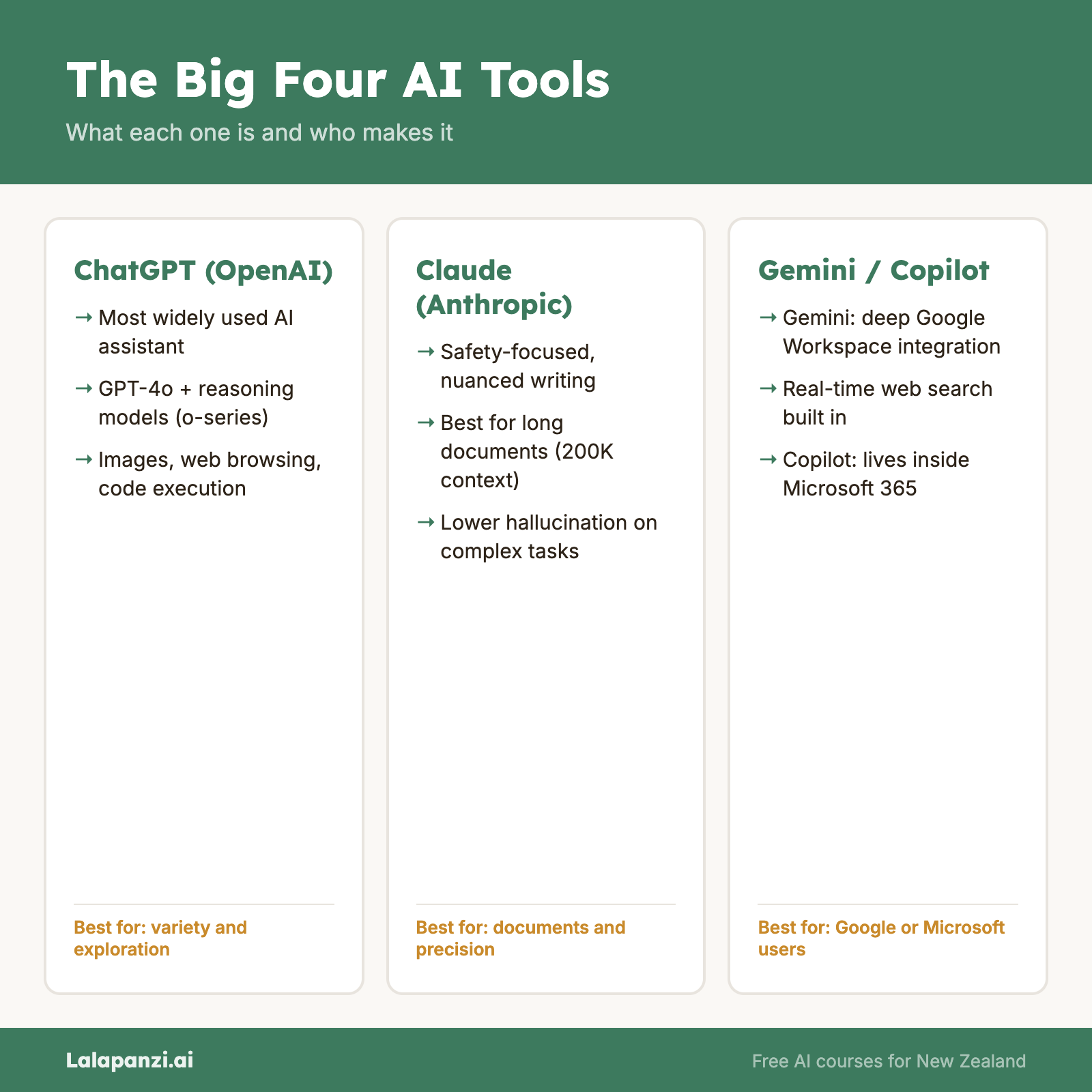
All four tools can do the basics — answer questions, write text, help with analysis. The differences show up in their strengths, their ecosystems, and how you access them:
- ChatGPT has the largest user base and the broadest feature set. It's the Swiss Army knife.
- Claude excels at long-form analysis, nuanced writing, and careful reasoning. It handles large documents particularly well.
- Gemini is strongest when connected to Google's ecosystem and when you need current web information.
- Copilot is most useful if you live in Microsoft 365 and want AI help inside the tools you already use.
None of them is "the best" in every situation. The best tool depends on what you're trying to do, what you're already using, and what you're willing to pay. We'll dig into those specifics in the next few lessons.
A Note on the Pace of Change
These descriptions are accurate as of August 2026, but this is one of the fastest-moving spaces in technology. Models get updated frequently — OpenAI alone runs roughly 90-day model lifecycles, and both Anthropic and Google have shipped multiple new model generations this year. We review this module monthly to keep it current — check the "last updated" date at the top.
The fundamentals, though, tend to hold: these four companies are well-resourced, widely used, and likely to remain major players for the foreseeable future. Learning how to use any one of them well will serve you regardless of what changes next.
2026 Must-Know Tools
While the big four remain essential, 2026 has seen the rise of specialised AI tools for specific New Zealand industries. Notable examples include AI-assisted farm management platforms like PastureAI and StockSense, healthcare diagnostics helpers such as MediScan NZ, and compliance tools tailored to NZ regulations like ComplyChain. These tools often build on the big four models but offer domain-specific workflows. Another growing trend is multi-model routing — tools that automatically send your query to the best model for the task (e.g. Gemini for image-heavy queries, Claude for coding, ChatGPT for general chat). Over 80% of organisations now use three or more models. For an overview of emerging consumer-facing AI features, see the AI Essentials course.
Key Takeaways
- There are four major general-purpose AI tools you're likely to encounter: ChatGPT, Claude, Gemini, and Copilot.
- Each is made by a different company with different priorities and strengths — there's no single "best" tool.
- All four can do the basics (writing, answering questions, analysis), but they differ in ecosystem, personality, and specialities.
- Free access is available for all four, though with limits. Paid tiers offer more.
- The landscape changes frequently, so focus on understanding what each tool does well rather than memorising specific features.
Practical Exercise
Try all four — with the same question.
- Open each of these tools (use the free tier for each):
- Ask each one the same question: "Explain what a large language model is in simple terms, as if I've never heard of AI before."
- Read all four responses. Note:
- Which explanation made the most sense to you?
- Which felt the most natural to read?
- Were there any noticeable differences in tone or detail?
- Write down your first impressions of each tool. There are no wrong answers — this is about developing your own sense of how these tools differ.
Knowledge Check
1. Which company makes Claude?
- a) OpenAI
- b) Google DeepMind
- c) Anthropic
- d) Microsoft
Answer: c) Anthropic
2. What is Microsoft Copilot's biggest advantage over the other tools?
- a) It's the cheapest option
- b) It integrates directly with Microsoft 365 apps like Word, Excel, and Outlook
- c) It uses a completely different type of AI
- d) It was the first AI tool available to the public
Answer: b) It integrates directly with Microsoft 365 apps like Word, Excel, and Outlook
3. Which of the following statements is true about all four major AI tools?
- a) They all require a paid subscription to use
- b) They are all made by the same company
- c) They can all handle basic tasks like writing and answering questions
- d) They all use the same underlying AI model
Answer: c) They can all handle basic tasks like writing and answering questions
Visual overview