Module 4, Lesson 5: Creative Tasks and When NOT to Use AI
Listen to this lesson
Module 4, Lesson 5: Creative Tasks and When NOT to Use AI
Estimated reading time: 8 minutes
AI and Creativity
AI tools can be genuinely useful for creative work. They can brainstorm ideas, generate first drafts, suggest angles you hadn't considered, and help you break through creative blocks. For many people, this is one of the most enjoyable ways to use AI.
But creative tasks are also where AI's limitations show most clearly — and where the question of when not to use AI becomes most important.
This lesson covers both sides: how to use AI effectively for creative work, and when to put the AI away entirely.
Where AI Helps With Creative Tasks
Brainstorming and ideation
AI is an excellent brainstorming partner. It doesn't get tired, doesn't judge your ideas, and can generate volume quickly.
Example prompts:
- "Give me 10 blog post ideas for a small accounting firm that wants to be more approachable on social media."
- "I'm planning a team-building event for 15 people in Wellington. Budget is $500. Give me 8 creative ideas that aren't the usual bowling or escape room."
- "I'm writing a presentation about workplace wellbeing. What are 5 unexpected angles I could take that would surprise the audience?"
Tip: Ask for quantity first, then refine. "Give me 20 ideas" gets you a broader range than "Give me your best idea." You can always narrow down afterwards.
Content planning
AI can help structure content plans for blogs, social media, newsletters, and presentations:
Example prompt: "Create a 4-week social media content plan for a NZ-based physiotherapy clinic. Mix educational posts, patient tips, team introductions, and seasonal content. Target audience: active adults aged 30-55."
First drafts of creative content
For social media posts, blog articles, marketing copy, and similar content, AI can produce solid first drafts that you then refine with your own voice and knowledge:
Example prompt: "Draft a LinkedIn post announcing that our company just won the Wellington Business Excellence Award. Tone should be proud but humble — not bragging. Keep it under 150 words."
Overcoming creative blocks
When you're stuck, AI can help you get moving:
- "I'm writing a report and I can't figure out how to open it. The report is about [topic]. Give me 5 different opening sentences to choose from."
- "I've been staring at this presentation for an hour. Here's my outline — suggest how to make the flow more engaging."
- "Rewrite this paragraph in three completely different styles: conversational, formal, and storytelling."
Adapting content for different audiences
Example prompt: "I have this technical explanation of our software product. Rewrite it for three audiences: (1) a CEO who cares about business impact, (2) a technical team lead who wants implementation details, (3) an end user who just wants to know what it does for them."
The Limits of AI Creativity
While AI is useful for creative support, it's important to understand what it's actually doing — and what it can't do.
AI remixes; it doesn't originate
AI generates content based on patterns it learned from existing text. It's very good at combining, adapting, and rephrasing ideas. It is not having original thoughts, making creative leaps, or bringing lived experience to the work.
This means AI-generated creative content often feels:
- Safe. It gravitates toward common patterns and popular approaches.
- Generic. Without specific guidance, it produces content that could have come from anyone.
- Missing a point of view. The most compelling creative work has a perspective — a specific human experience or opinion behind it. AI doesn't have one.
The "good enough" trap
AI can produce content that's perfectly adequate. Professional-sounding blog posts. Reasonable social media captions. Acceptable marketing copy. And for some tasks, adequate is all you need.
But "good enough" can become a ceiling. If all your content is AI-generated and lightly edited, it will eventually sound like everyone else's AI-generated content. Your audience may not notice one generic post, but they'll notice a pattern of them.
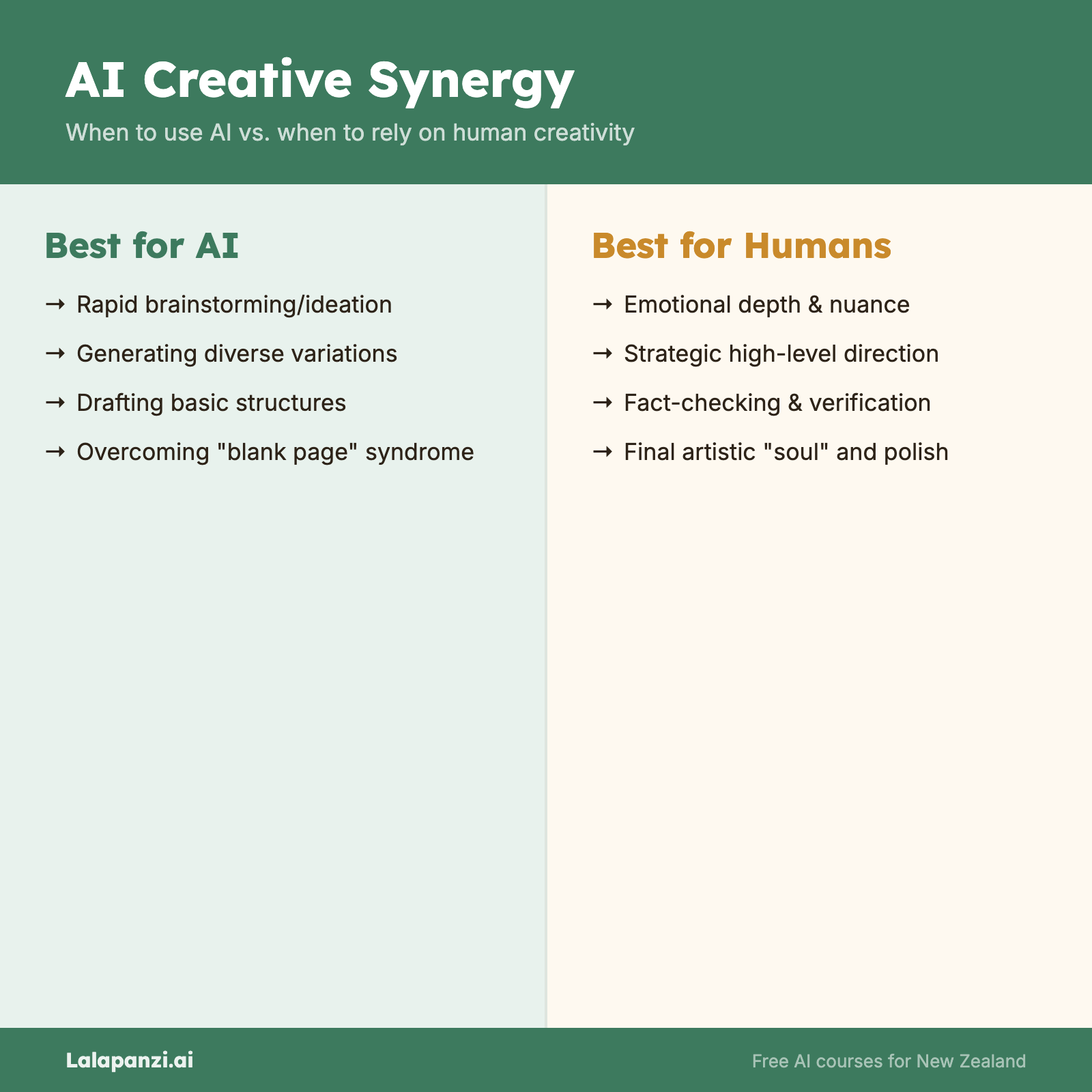
The best approach: use AI for the grunt work (brainstorming, first drafts, variations) and invest your human effort in the parts that make the content distinctly yours — your perspective, your stories, your expertise.
When NOT to Use AI
This is arguably the most important section in this entire module. Knowing when to use AI is valuable; knowing when not to is essential.
When accuracy is critical and you can't verify
If you need to produce content with specific facts — legal information, medical advice, financial data, historical claims — and you don't have the expertise or time to verify every detail, AI is risky. It will produce confident, fluent text regardless of whether the facts are correct.
Rule: If getting it wrong has real consequences, and you can't personally verify the output, don't rely on AI.
When the work IS the thinking
Sometimes the value of a task isn't the output — it's the process of doing it. Writing a strategic plan, reflecting on a difficult decision, working through a complex problem — these activities develop your thinking. Outsourcing them to AI gives you a document, but you miss the insight that comes from working through it yourself.
Ask yourself: Am I trying to produce a document, or am I trying to think through a problem? If it's the latter, do the thinking yourself. You can use AI to refine the output afterwards.
When personal connection matters
Some writing needs to come from you — genuinely. A condolence message to a colleague. A heartfelt thank-you to your team. A recommendation for someone you know well. Performance feedback for a direct report.
Using AI for these isn't just lazy — it's dishonest in a way the recipient may feel even if they can't pinpoint why. When the message is about the relationship, write it yourself.
When it could cause harm
- Health decisions. AI is not a doctor. Don't use it to diagnose, treat, or make medical decisions.
- Legal matters. AI is not a lawyer. Don't rely on it for legal advice that affects real outcomes.
- People decisions. Hiring, firing, disciplinary actions — these deserve human judgment, not AI-generated assessments.
- Sensitive cultural content. AI doesn't have cultural understanding. Content involving te reo Māori, tikanga, or cultural protocols should involve people with genuine cultural knowledge.
When it violates trust
If your employer, client, or institution expects original work and you present AI-generated content as your own, that's a trust issue. Policies on AI use vary widely — some organisations embrace it, others prohibit it for specific tasks. Know where you stand.
When it's replacing skill development
If you're early in your career or learning a new skill, using AI as a shortcut can prevent you from developing the competence you need. A graduate who uses AI to write every email may never develop their own professional writing voice. A student who uses AI for every assignment misses the learning the assignment was designed to create.
Use AI to learn faster, not to avoid learning.
A Simple Decision Framework
Before using AI for a task, ask:
- Does accuracy matter, and can I verify the output? If accuracy matters and you can't verify → don't use AI.
- Is the thinking the point? If the process of doing the work is where the value lies → do it yourself.
- Does it need to be genuinely personal? If the message is about a human relationship → write it yourself.
- Could it cause harm if it's wrong? If errors have real consequences for health, legal standing, or people's lives → don't rely on AI.
- Am I expected to do this myself? If there's an expectation of original work → be transparent about AI use or don't use it.
If you clear all five, AI away.
Key Takeaways
- AI is a strong creative support tool — excellent for brainstorming, first drafts, content planning, and overcoming creative blocks.
- AI creativity has limits — it remixes patterns rather than originating ideas, and tends toward safe, generic output without strong guidance.
- Don't use AI when accuracy is critical and you can't verify, when the thinking process is the point, when personal connection matters, or when errors could cause harm.
- The "good enough" trap is real — if all your content is AI-generated, it will eventually sound like everyone else's.
- Use AI for the grunt work; invest your human effort in perspective, stories, and expertise — that's what makes content distinctly yours.
Practical Exercise
Create something with AI — then make it yours.
- Choose a creative task:
- A social media post for your business or personal brand
- A short blog post or article on a topic you know well
- A presentation outline for an upcoming talk or meeting
- A content plan for the next month
- Use AI to generate a first draft or brainstorm ideas.
- Now, critically review the AI output:
- What's generic that you could make specific?
- Where could you add your own experience or perspective?
- What would you never say in your own voice?
- Rewrite or heavily edit the output until it sounds like you — your voice, your knowledge, your point of view.
- Compare the AI draft with your final version. What did you change, and why?
The goal: understand the difference between AI-generated content and content that's genuinely yours.
Knowledge Check
1. What is the main limitation of AI-generated creative content?
- a) It's always factually incorrect
- b) It tends to be safe and generic, lacking a personal perspective or original point of view
- c) It can only produce text, not ideas
- d) It takes longer than writing manually
Answer: b) AI-generated creative content tends toward safe, generic patterns because it remixes existing content rather than bringing original perspective or lived experience.
2. When should you definitely NOT use AI?
- a) When drafting a social media post
- b) When brainstorming ideas for a presentation
- c) When writing a personal condolence message to a grieving colleague
- d) When creating a content plan for the quarter
Answer: c) Personal messages that are about human relationships should come genuinely from you — using AI for these undermines the connection.
3. What's the recommended approach for using AI in creative work?
- a) Generate the final version with AI and publish without editing
- b) Avoid AI entirely for any creative task
- c) Use AI for brainstorming and first drafts, then invest your own effort in adding perspective, voice, and specificity
- d) Only use AI for tasks that take more than 4 hours
Answer: c) Use AI for the grunt work (brainstorming, first drafts, variations) and invest your human effort in the parts that make the content distinctly yours.
Visual overview