Module 4, Lesson 2: Research and Analysis — What AI Can Reliably Help With
Listen to this lesson
Module 4, Lesson 2: Research and Analysis — What AI Can Reliably Help With
Estimated reading time: 8 minutes
AI as a Research Assistant
AI tools can feel like having a knowledgeable colleague available around the clock. Ask a question, get an answer. Upload a document, get analysis. It's genuinely useful — but it comes with a catch that you need to understand clearly.
AI tools can be confidently wrong. They present information fluently regardless of whether it's accurate. This doesn't make them useless for research — far from it. But it means you need to use them as a starting point, not a source of truth.
This lesson covers what AI can reliably help with in research, what it can't, and how to use it wisely.
What AI Does Well in Research
Explaining unfamiliar topics
This is where AI shines. If you're entering a new field, encountering an unfamiliar concept, or trying to understand something complex, AI tools are excellent at providing clear, accessible explanations.
Example prompt: "I'm a small business owner with no finance background. Explain what EBITDA is and why it matters, in plain language."
AI is particularly good at this because:
- It can adapt its explanation to your level of knowledge
- It can provide analogies and examples on request
- You can ask follow-up questions in real time
- It's patient — you can ask it to re-explain differently without feeling awkward
Comparing options
Need to understand the differences between two approaches, products, or strategies? AI is good at structured comparisons.
Example prompt: "Compare the pros and cons of Xero vs MYOB for a small service-based business in New Zealand with 5 employees. I care about ease of use, cost, and payroll features."
Literature review and synthesis
If you have several documents or articles on a topic, AI can help you find themes, contradictions, and key points across them. Upload the documents and ask:
Example prompt: "I'm uploading 5 articles about remote work productivity. Summarise the key findings across all of them. Where do they agree? Where do they disagree?"
Brainstorming and hypothesis generation
AI is useful for generating ideas and angles you might not have considered.
Example prompt: "I'm researching why staff turnover is high in our customer service team. What are the most common causes of turnover in customer-facing roles? What questions should I be asking in exit interviews?"
Understanding data and statistics
If you encounter statistics or data in a report, AI can help you interpret what they mean.
Example prompt: "This report says our NPS score dropped from 42 to 35 quarter-over-quarter. Is that a significant drop? What might cause that kind of change?"
What AI Can't Reliably Do
Provide verified facts
AI tools generate text based on patterns in their training data. They don't "look up" facts in a database. This means:
- They can state incorrect facts with complete confidence
- They can invent citations, studies, and statistics that don't exist
- They may present outdated information as current
- They may blend accurate and inaccurate information in the same paragraph
Rule of thumb: If a specific fact, number, or claim matters, verify it independently. Search for the source. Check the original. Don't treat AI output as a citation.
Replace domain expertise
AI can explain what a legal concept means. It can't give you legal advice for your specific situation. The same applies to medical, financial, tax, and engineering domains. AI doesn't understand your context the way a qualified professional does.
Use AI to prepare for conversations with experts, not to replace those conversations.
Guarantee recency
Most AI models have a training data cutoff — they don't know about events after a certain date. Tools with web browsing (ChatGPT, Gemini, Perplexity) can access current information, but even these can miss very recent developments or mix current and outdated information.
Always check: "When was this information current?" If the AI doesn't specify, ask.
Understand your specific context
AI doesn't know your organisation, your market, your customers, or your history. It can give general advice, but the most valuable research insights come from applying general knowledge to specific contexts — and that's still a human skill.
A Practical Research Workflow
Here's a workflow that makes the most of AI's strengths while protecting against its weaknesses:
Step 1: Start with AI for orientation
Ask the AI to explain the topic, identify key concepts, and suggest what to look into further. This gives you a map of the territory.
Step 2: Go deeper with targeted questions
Once you understand the basics, ask more specific questions. Upload relevant documents for the AI to analyse. Ask it to compare sources, identify gaps, or challenge assumptions.
Step 3: Verify independently
For any facts, statistics, or claims that matter:
- Search for the original source
- Check whether the source is credible and current
- Cross-reference with at least one other source
- Use Perplexity AI or Google Scholar for sourced answers
Step 4: Synthesise with your own judgment
AI can gather and organise information, but the synthesis — deciding what it means for your situation — is yours. The AI doesn't know what you know.
Step 5: Document your sources
If your research will inform a decision or be shared with others, note where your information came from. "AI-assisted research, verified against [source]" is honest and appropriate.
Tools for Research
Different tools suit different research needs:
- Perplexity AI — Best for sourced answers. It cites its sources, making verification easier.
- Claude — Best for analysing long documents. Upload reports or articles and ask detailed questions about them.
- ChatGPT — Best for broad explanations and multi-step research conversations. Its code execution can help with data analysis.
- Gemini — Best for questions requiring current web information, especially if integrated with Google Workspace.
- Google Scholar — Not AI, but essential for academic research. Use AI to understand papers, not to find them.
The Verification Habit
The single most important skill for using AI in research is developing a verification habit. Not everything needs to be fact-checked — if you're using AI to brainstorm ideas, the ideas themselves don't need verification. But when you're dealing with:
- Specific facts or statistics
- Historical claims
- Scientific or medical information
- Legal or regulatory information
- Information about real people or organisations
...always verify before relying on it.
This isn't a weakness of AI tools — it's how research has always worked. You wouldn't cite a single Wikipedia article without checking the sources. AI deserves the same healthy scepticism.
Key Takeaways
- AI is excellent for explaining concepts, comparing options, and brainstorming — use it as a starting point for research, not the finish line.
- AI can be confidently wrong — always verify specific facts, statistics, and claims independently.
- AI doesn't replace domain expertise — use it to prepare for expert conversations, not to avoid them.
- A good research workflow uses AI for orientation and synthesis, then verifies important claims through independent sources.
- Developing a verification habit is the most important skill for AI-assisted research.
Practical Exercise
AI-assisted research on a real topic.
- Choose a topic you genuinely need to learn about — something for work, a decision you're making, or a subject you're curious about.
- Use an AI tool to get an initial overview:
- "Explain [topic] to me. What are the key things I should understand?"
- "What are the main arguments for and against [approach]?"
- Identify three specific claims the AI makes in its response.
- Verify each claim using independent sources (Google search, original reports, official websites).
- Record your results:
- Were the AI's claims accurate?
- Were any misleading or incomplete?
- How long did verification take compared to the initial AI research?
Knowledge Check
1. What is the most important habit to develop when using AI for research?
- a) Trusting AI outputs completely to save time
- b) Only using AI for creative brainstorming, never for research
- c) Verifying specific facts and claims independently before relying on them
- d) Avoiding AI tools entirely for serious research
Answer: c) Verifying specific facts and claims independently — AI can be confidently wrong, so important information should always be checked.
2. What is AI particularly good at during the research process?
- a) Providing guaranteed accurate citations
- b) Replacing the need for domain experts
- c) Explaining unfamiliar concepts, comparing options, and helping synthesise information from multiple sources
- d) Giving legally binding advice
Answer: c) AI excels at explaining concepts, structured comparisons, and synthesis — tasks that help you understand a topic quickly.
3. Why should AI not be treated as a replacement for professional advice (legal, medical, financial)?
- a) AI is too expensive for professional use
- b) AI doesn't understand your specific context and can present incorrect information confidently
- c) AI refuses to answer professional questions
- d) Professionals are always faster than AI
Answer: b) AI lacks understanding of your specific context and can be confidently wrong — professional advice requires qualified human judgment.
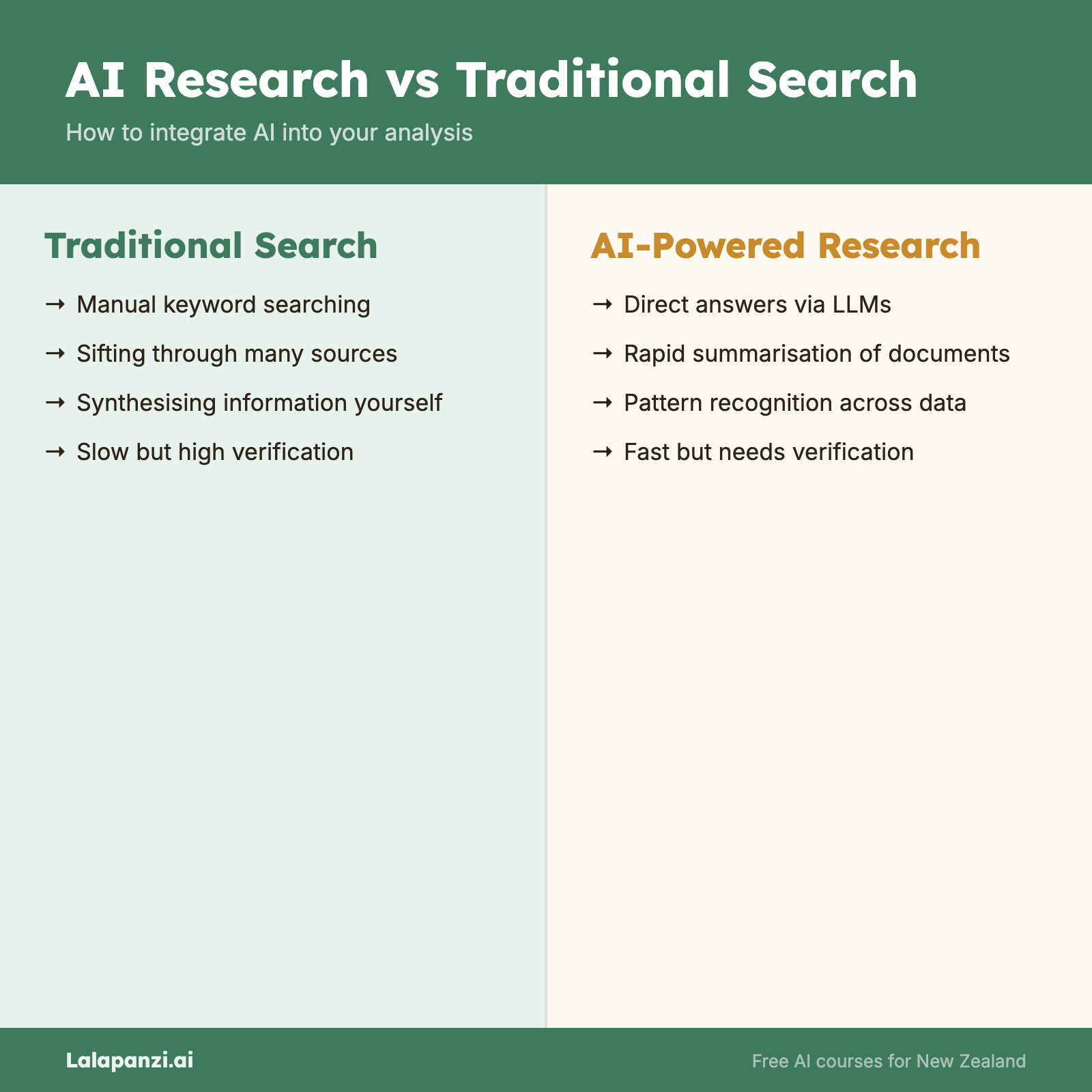
Visual overview