Types of AI: Narrow vs General
Listen to this lesson
Lesson 1.3 — Types of AI: Narrow vs General
Estimated reading time: 7 minutes
Not all AI is the same
When people hear "artificial intelligence," they tend to picture one of two things: a helpful chatbot that writes emails, or a sentient robot plotting world domination. The reality is far less dramatic — and far more useful to understand.
AI exists on a spectrum, and where a system sits on that spectrum determines what it can do, what it can't, and how worried (or excited) you should be about it.
Let's break this down properly.
Narrow AI (what we actually have)
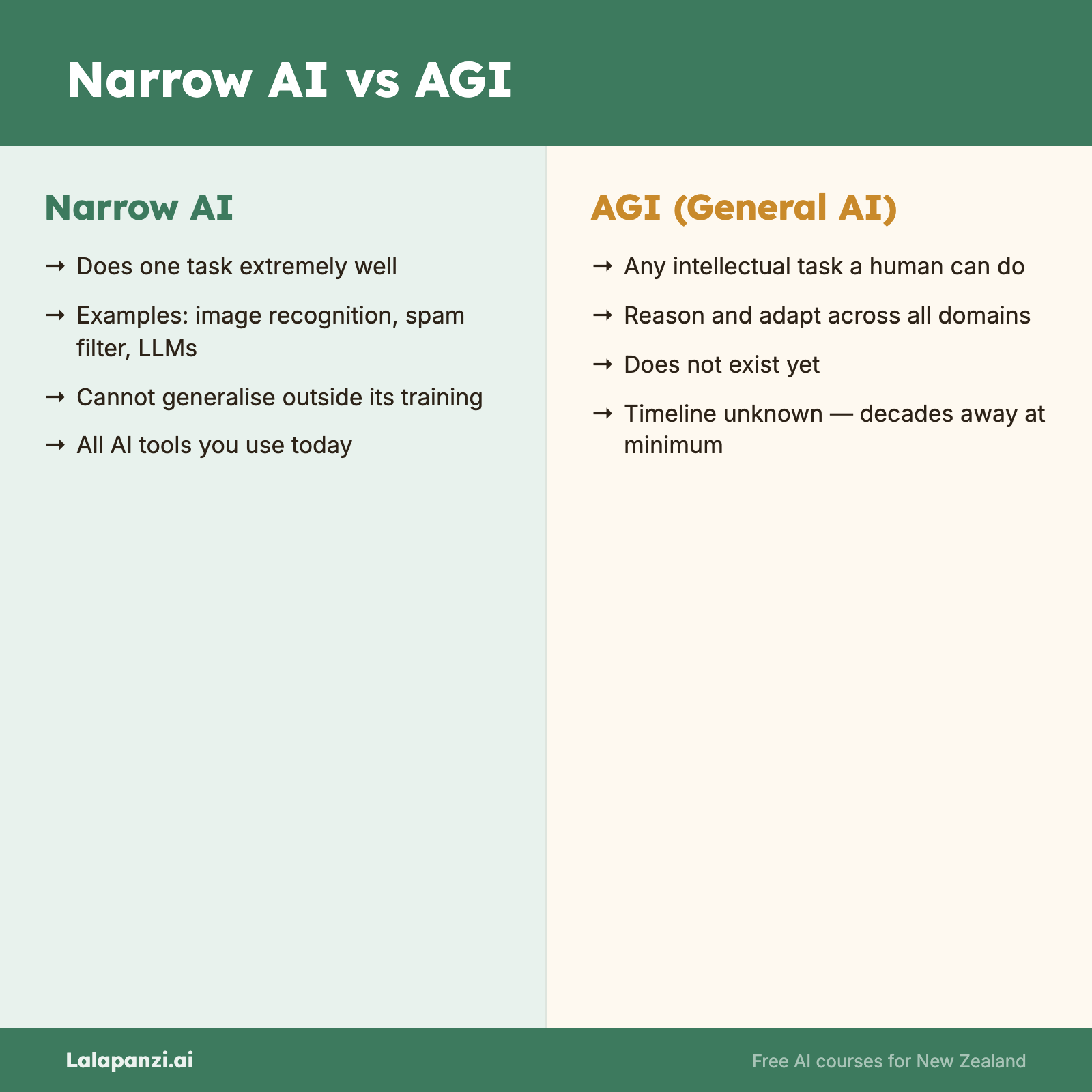
Every AI system you've ever used is narrow AI — also called weak AI or Artificial Narrow Intelligence (ANI). This isn't an insult. "Narrow" just means the system is designed to do one thing or a related set of things.
Examples of narrow AI:
- Spam filters — excellent at sorting email, hopeless at everything else
- Navigation apps — brilliant at route planning, can't write a poem
- Facial recognition — can identify faces in photos, can't tell you what those people are feeling
- Chess engines — can beat any human at chess, can't play draughts without being completely rebuilt
- Recommendation systems — Netflix knows what you might watch next, but couldn't book you a restaurant
Even the most impressive AI tools you've heard of — ChatGPT, Claude, Gemini — are narrow AI. Yes, they can do a remarkably wide range of language-based tasks: write, summarise, translate, code, analyse, brainstorm. But they can't drive a car, control a robot, or actually understand what they're writing. They operate within a specific domain (language) and lack the general-purpose intelligence that humans take for granted.
"But wait," you might think, "ChatGPT can do so many things. Isn't that general?" It's a fair question, and it highlights why the narrow/general distinction matters. ChatGPT is extremely versatile within language tasks. But versatile isn't the same as general. A Swiss Army knife has many tools, but it's still a pocket knife — it's not a workshop.
General AI (what we don't have)
Artificial General Intelligence (AGI) — sometimes called strong AI — refers to a system that can perform any intellectual task a human can. Not just language. Not just chess. Everything.
An AGI system would be able to:
- Learn a completely new skill without being retrained from scratch
- Transfer knowledge from one domain to another (the way you use cooking intuition to help with chemistry)
- Understand context, nuance, and meaning — not just patterns
- Reason about things it's never encountered before
- Set its own goals and figure out how to achieve them
We don't have this. Nobody has this. Despite what some headlines might suggest, no company has built AGI, and credible researchers disagree about whether it's five years away, fifty years away, or fundamentally impossible.
This is important to understand because a lot of AI hype relies on blurring the line between narrow and general AI. Someone shows you a chatbot writing a decent essay and implies we're on the verge of machines that think like people. We're not. What we have is extraordinary pattern matching at scale — which is genuinely useful, but categorically different from general intelligence.
Superintelligent AI (what we definitely don't have)
For completeness: Artificial Superintelligence (ASI) would be an AI system that exceeds human intelligence in every domain. This is the stuff of science fiction and long-term philosophical debate. It's worth knowing the term exists, but it's not relevant to your practical use of AI today. Nobody is building superintelligence. The conversation is largely theoretical.
If someone brings up superintelligence in a business meeting, you can politely redirect to the narrow AI that actually exists and is actually useful right now.
Why the distinction matters for you
Understanding that all current AI is narrow has several practical implications:
1. Set realistic expectations. When you use an AI tool, it will be excellent at some things and poor at others. A language model won't reliably do maths (it's processing language, not calculating). An image generator won't understand the physics of what it's drawing. Knowing this prevents frustration.
2. Choose the right tool. Because AI is narrow, different tools are built for different tasks. You wouldn't use a translation AI for data analysis. Matching the tool to the task is a core skill we'll build throughout this course.
3. Stay grounded amid hype. When a company claims their AI "thinks" or "understands" or "reasons," you now know to ask: what does it actually do? What's its narrow domain? What are its limits? These are the questions that cut through marketing language.
4. Appreciate what narrow AI can do. Narrow doesn't mean weak. Narrow AI systems can outperform humans in their specific domains — diagnosing certain cancers from medical images, predicting protein structures, processing thousands of legal documents in minutes. The constraint isn't capability within the domain; it's the inability to step outside it.
The current frontier
There's interesting work happening at the boundary between narrow and general AI. Large language models are increasingly being connected to other tools — calculators, web browsers, code interpreters, image generators. These AI agents can string together multiple capabilities to complete complex tasks.
Is this getting closer to AGI? Maybe a little. But connecting specialised tools together isn't the same as genuine general intelligence. It's more like building a very impressive Rube Goldberg machine — clever, useful, but still fundamentally a collection of narrow capabilities orchestrated by another narrow capability.
The honest answer is: we don't know exactly where the line between very capable narrow AI and true AGI sits, and we don't know when (or if) it will be crossed. What we do know is that the narrow AI available right now is powerful enough to be genuinely useful in your work and life — and that's what this course focuses on.
A note on terminology
You'll see these terms used loosely in the media. A few clarifications:
- "AI" usually means narrow AI in practice, even when headlines imply something grander
- "AGI" is used by some tech leaders to describe goals that are years or decades away
- "Strong AI" and "weak AI" are older academic terms for general and narrow AI — they're falling out of common use
- "AI model" refers to a specific trained system (like GPT-4 or Claude) — not the concept of AI as a whole
Don't get hung up on terminology. What matters is understanding what the system in front of you can and can't do.
Key Takeaways
- All current AI is narrow AI — designed for specific tasks or domains, not general-purpose thinking
- AGI (general AI) doesn't exist yet and there's no consensus on when or whether it will
- Narrow doesn't mean weak — narrow AI can outperform humans within its specific domain
- Understanding the distinction helps you set realistic expectations and choose the right tools
- Be sceptical of claims that blur the line between narrow and general AI — that's usually hype
Practical Exercise
Test the boundaries of a narrow AI.
Pick an AI chatbot you have access to (ChatGPT, Claude, Gemini, or any other). Try giving it tasks across different categories and rate how well it performs (1 = poor, 5 = excellent):
- Write a professional email declining a meeting
- Solve a multi-step maths word problem
- Describe what's in a photo (if the tool supports image input)
- Give you driving directions from your home to a nearby town
- Explain a legal concept relevant to New Zealand
- Tell you what the weather will be like tomorrow
- Write a short poem about your hometown
For each task, note: Did it do well? Where did it struggle? What does this tell you about the boundaries of this particular narrow AI?
Write a short paragraph summarising what you found. Where are the edges of this tool's capabilities?
Knowledge Check
1. What is narrow AI?
a) AI that only works for a narrow group of people
b) AI designed for specific tasks or domains, which describes all current AI systems
c) AI that is less powerful than a human in every way
d) AI that can only process small amounts of data
Answer: b) Narrow AI is designed for specific tasks or domains. Every AI system in use today — including ChatGPT and Claude — is narrow AI.
2. What is Artificial General Intelligence (AGI)?
a) AI that has been generally approved by regulators
b) AI that can generate any type of content
c) A hypothetical AI that can perform any intellectual task a human can
d) AI that is generally available to the public
Answer: c) AGI refers to a hypothetical system that could match human-level intelligence across all domains. It doesn't exist yet.
3. Why is it useful to know that all current AI is narrow?
a) So you can avoid using it
b) So you can set realistic expectations about what AI tools can and can't do
c) So you can invest in the right AI companies
d) So you can argue with people online about AI
Answer: b) Understanding that AI is narrow helps you set realistic expectations, choose the right tools for specific tasks, and see through hype.
Visual overview